
January 23, 2026
Winter Lightning: Hundreds of Times More Powerful Than Summer Lightning How Companies Are Preventing Business Disruptions Caused by Lightning Strikes



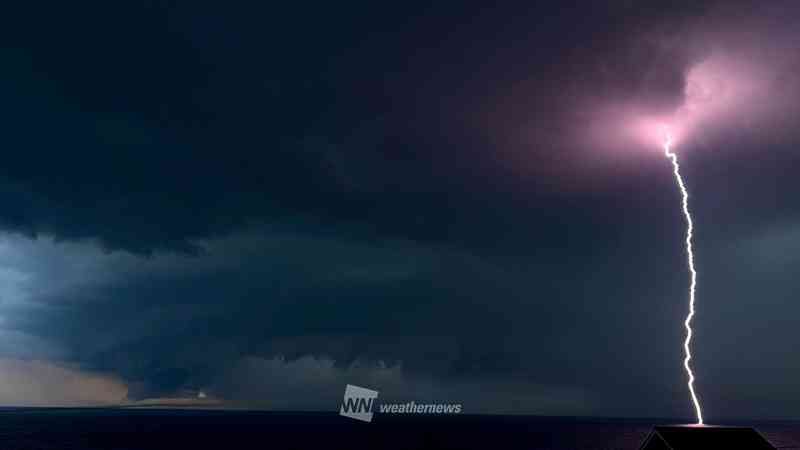
When you think of lightning, summer storms probably come to mind. But in Japan, it's actually winter lightning that demands the most attention.
Winter lightning occurs primarily along the Sea of Japan coast and in the Hokuriku region. Not only does it strike more frequently than summer lightning, but a single strike can release hundreds of times more energy. This destructive power poses a serious threat to business continuity, causing everything from factory shutdowns to accidents at sports facilities.
In this article, we'll take a closer look at the critical differences between summer and winter lightning, the mechanisms behind the intense lightning activity along the Sea of Japan coast, and the latest solutions that help businesses protect themselves from lightning-related risks.
The Real Lightning Season Is Winter: Winter Lightning Can Be Hundreds of Times Stronger Than Summer Lightning
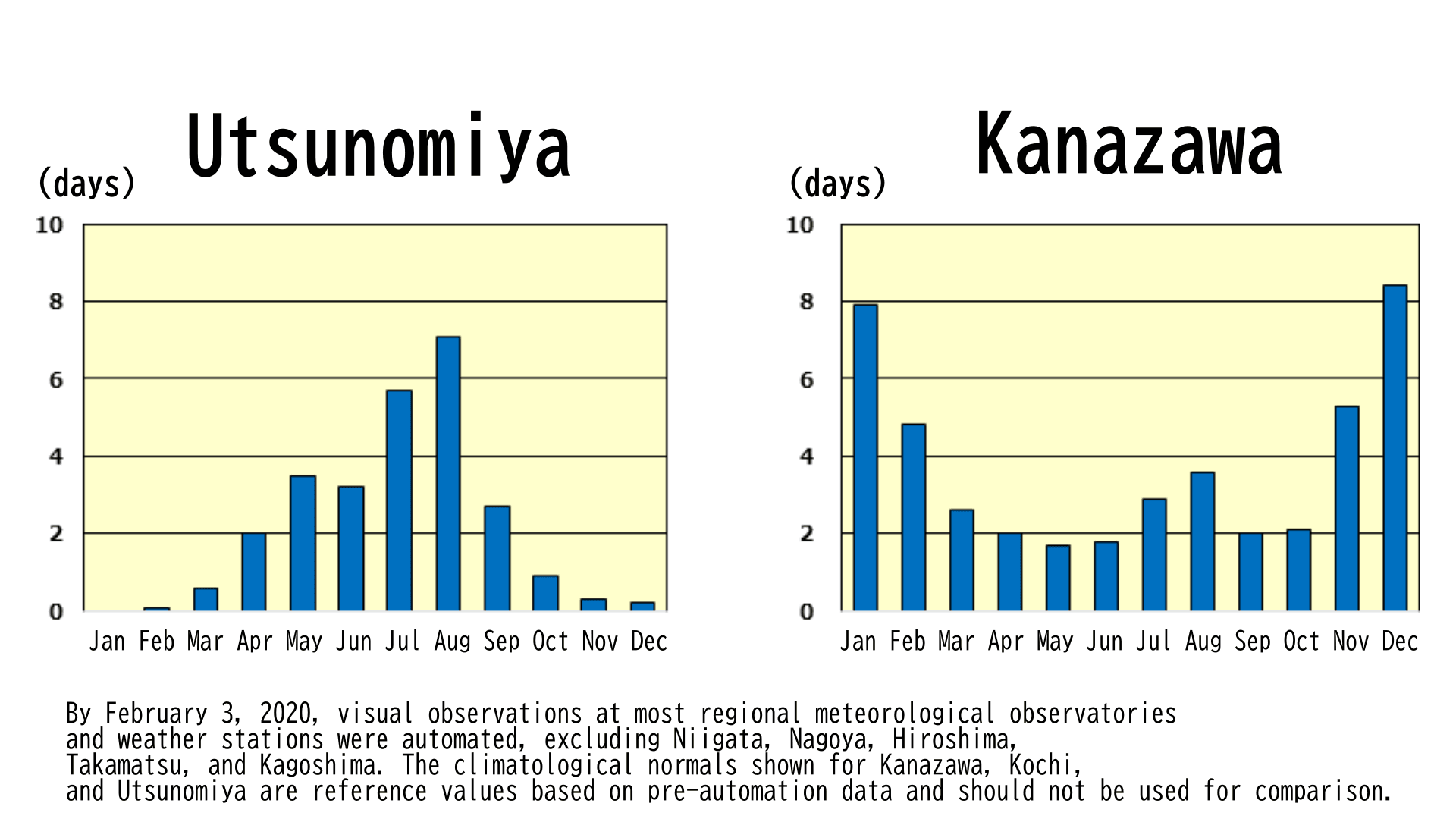
When it comes to lightning activity, Ustunomiya City in Tochigi Prefecture is known as a “lightning hotspot” in the Kanto region, experiencing approximately 26.5 lightning days per year. In comparison, Kanazawa City in the Hokuriku region records around 45.1 lightning days annually–nearly double that of Utsunomiya–making it one of Japan’s most lightning-prone areas.
A closer look at the data reveals an interesting pattern. Ustnomiya experiences most of its lightning during the summer months, from July to September. Kanazawa, however, sees its peak lightning activity in winter, particularly in December and January. While both are caused by cumulonimbus cloud development, differences in where and how these clouds form lead to distinct patterns in seasonality and frequency.
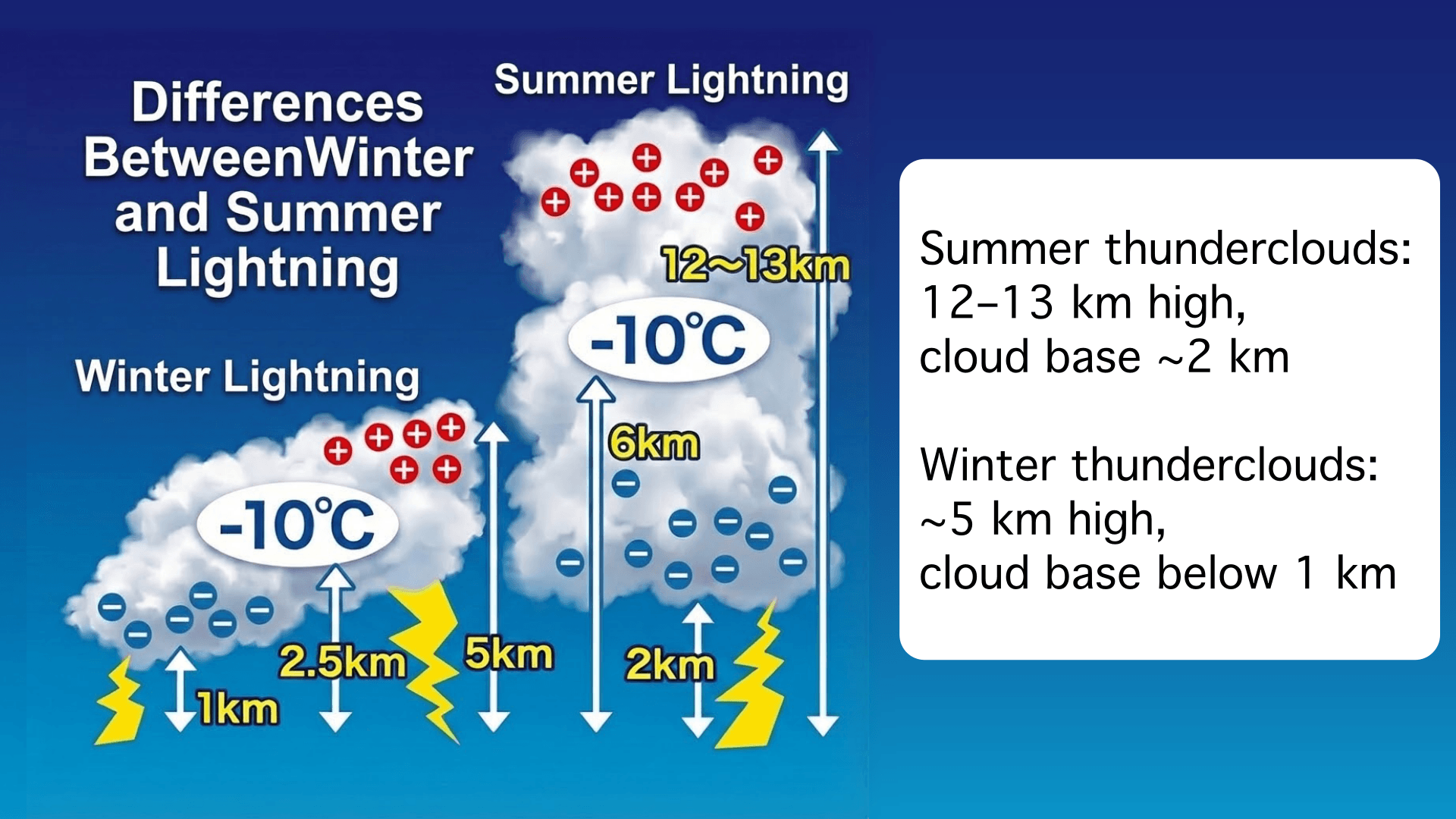
Winter lightning is known to occur more frequently than summer lightning. Summer thunderstorms develop tall, vertical clouds as abundant heat and moisture allow them to grow upward to great heights. Winter lightning on the other hand, forms within band-shaped cloud systems, where clouds line up and spread horizontally across wide areas. This horizontal expansion leads to a higher number of lightning strikes Another major difference lies in the energy of each lightning strike.
Summer thunderclouds typically have cloud bases around 2 km above the ground, with cloud tops reaching 12–13 km high. Winter thunderclouds, however, form much closer to the surface. The distance from cloud base to the ground is often less than 1 km, and in some cases just 300–500 meters. Because of this dramatically shorter distance, winter lightning can carry hundreds of times more energy than summer lightning. In terms of raw power, winter lightning is overwhelmingly stronger.
Why Is Winter Lightning Concentrated Along the Sea of Japan Coast?
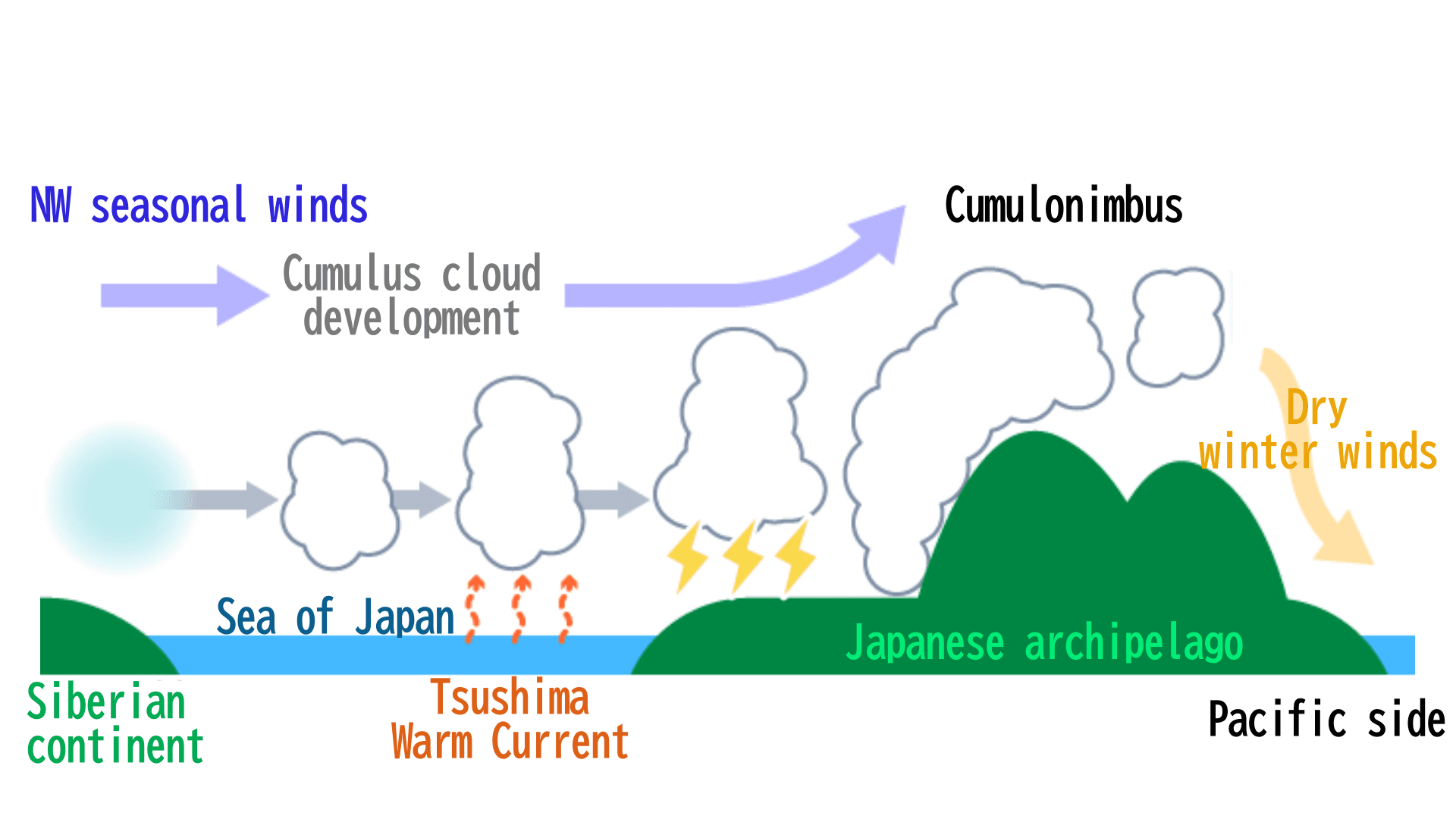
The region stretching from Niigata to Fukui is sometimes called a “severe lightning zone.” So why does winter lightning occur so frequently along the Sea of Japan coast?
Winter cumulonimbus clouds form when cold air masses form Siberia move across the relatively warm waters of the Sea of Japan, which are warmed by the Tsushima Current. This temperature contrast provides abundant water vapor, allowing thunderclouds to develop rapidly. As these clouds grow, seasonal winds carry them toward the Sea of Japan coast, resulting in the region’s frequent winter lightning activity.
You might wonder whether these lightning-producing clouds eventually reach the Pacific side of Japan. In fact, after bringing snow and lightning to the Sea of Japan side, the clouds gradually weaken or break apart as they encounter mountain ranges. By the time they cross over to the other side, they've typically transformed into dry winds that no longer produce lightning along the Pacific coast.
Lightning Countermeasures Using “Weathernews for business,” Used at the Osaka World Expo and Fuji Rock Festival
In recent years, serious lightning-related incidents have continued to occur—from accidents during outdoor sporting events to factories forced to halt operations for up to 10 days following lightning strikes. To help protect both lives and businesses from such weather risks, Weathernews provides Lightning Risk Monitoring as part of its corporate weather information service, Weathernews for business1.
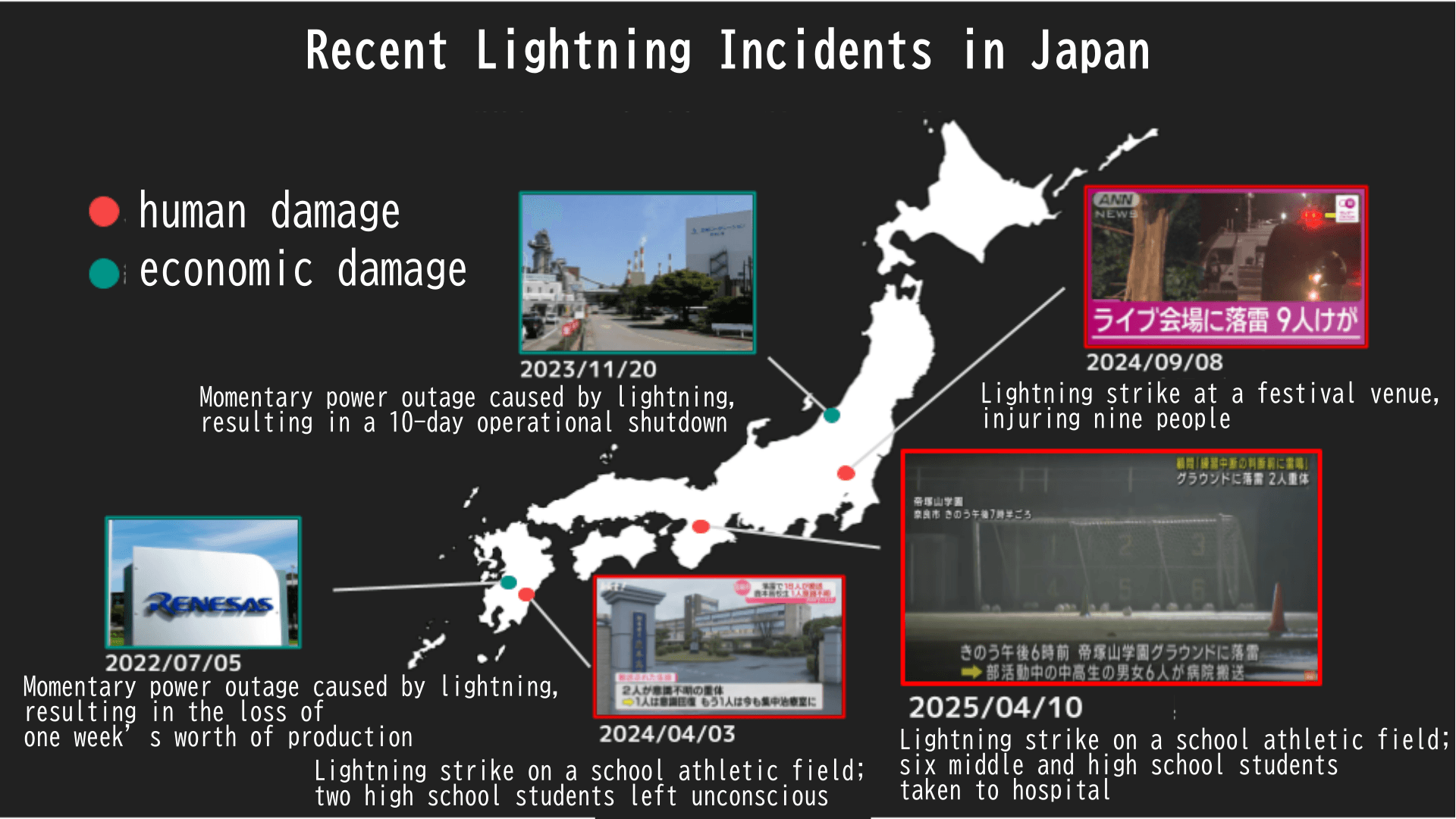
The most critical aspect of lightning countermeasures is detecting when and where risks are increasing as early as possible.
This service provides both proprietary lightning risk forecasts and real-time lightning observations. One of its key features is the ability to send push notifications directly to users’ smartphones. Even when checking a PC isn't possible—such as during outdoor work or event operations—users can instantly assess the current risk level and make quick decisions about evacuations or suspending activities.
The service also categorizes short-term lightning risk into three levels: ・No current lightning risk ・Lightning risk within 1 hour ・Lightning risk beyond 1 hour
This framework supports on-site decision-making based on lightning forecasts. Organizations use the system to decide whether to suspend, cancel, or resume sporting events; prepare for power outages or voltage fluctuations at manufacturing facilities; switch to backup power generation; and implement lightning surge protection measures.
At the Osaka–Kansai Expo, the service was used for emergency lightning announcements and visitor safety guidance. When lightning risk increased, emergency broadcasts were immediately issued, security teams guided visitors to evacuation areas, and relevant staff were notified to carry out lightning-response procedures. The system's map-based monitoring areas—displayed as circles—made it easy to identify lightning strike locations and assess approaching risks2.
This service is also used at CMK Corporation's factories, which manufacture printed circuit boards for automotive applications3, as well as by the organizing team for the outdoor music festival, Fuji Rock4.
The appropriate area for monitoring lightning risk varies by industry. This service allows users to customize monitoring zones to fit their specific needs, such as:
・Prioritizing surveillance along power transmission lines ・Expanding monitoring areas to the west of facilities to track incoming rain cloud movement
We will continue to leverage our high-resolution, high-accuracy weather data to develop services that align closely with our customers' evolving needs.
Footnotes
- 1:Corporate weather information service for businesses, “Weathernews for business” ↩︎
- 2:Case Studies : Osaka World Expo ↩︎
- 3:Case Studies : CMK Japan Co. ↩︎
- 4:Case Studies : Fuji Rock Festival ↩︎
Share
March 27, 2026
Ogasawara Islands to Achieve Japan's Highest Weather Observation Density Through Digital Innovation
March 16, 2026
Japan's Most Comprehensive Cherry Blossom Forecast: How Our Proprietary Bloom Prediction Model Leverages User-Generated Photos and High-Precision Data Across 1,400 Locations
March 13, 2026
How TV Stations Are Transforming Weather Coverage A New Content Solution Helping Broadcasters Navigate Weather and Disaster Reporting