[Transcript] Mid-Term Vision 2026 Presentation
July 22, 2026
Script for the Mid-Term Vision 2026 Presentation
Download the Presentation Materials
Thank you all for joining us today. Let me walk you through Mid-Term Vision 2026.
Until now, we have worked from three-year medium-term business plans. This Mid-Term Vision also looks roughly three years ahead. But market conditions are changing rapidly these days, and the outlook may shift significantly from year to year, so we have designed Mid-Term Vision 2026 to be updated every year.
First, the vast market opportunity before us.
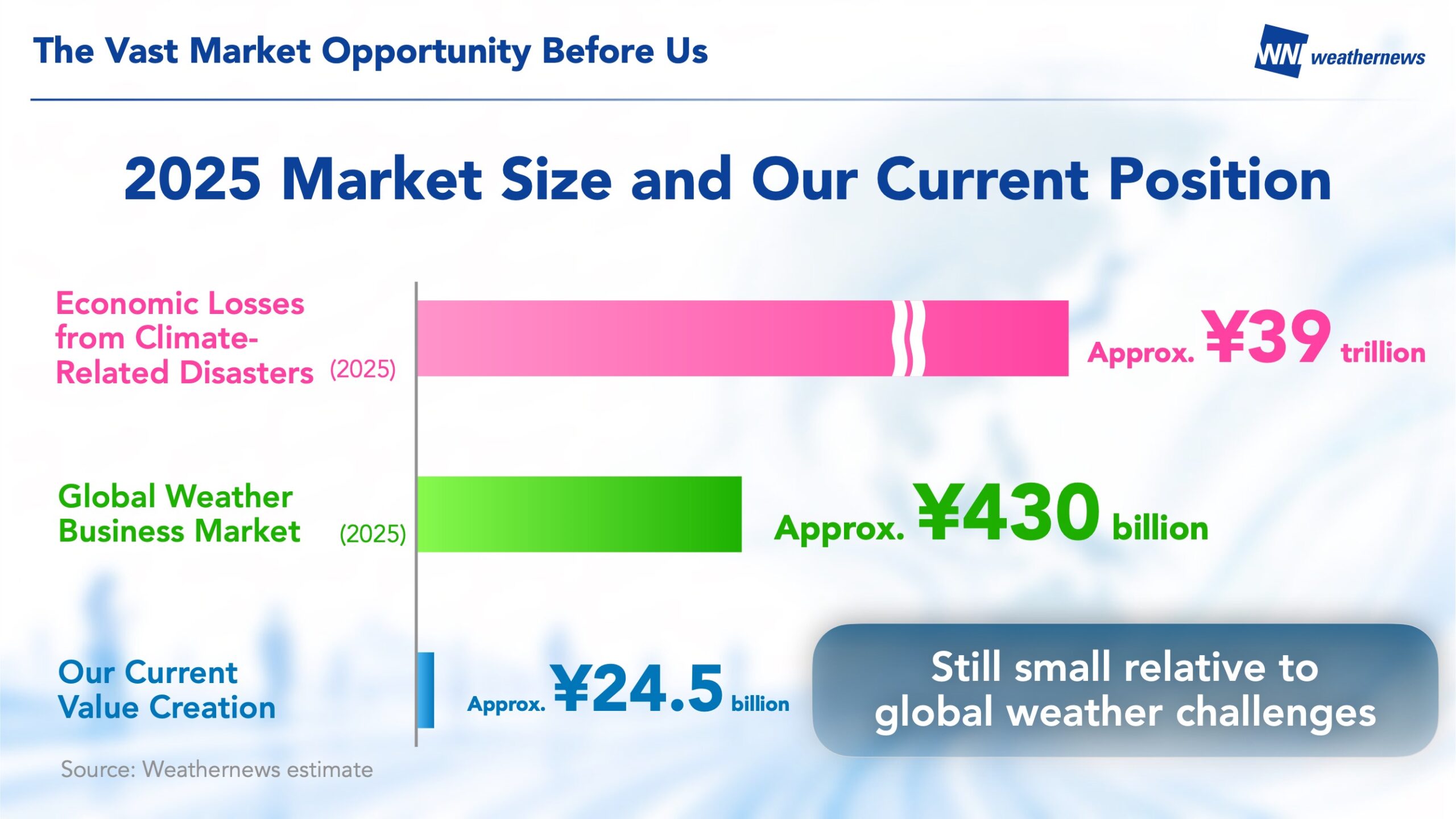
The global weather market was worth about JPY430 billion in 2025, and we account for about JPY24.5 billion of that. By contrast, climate change and the disasters that come with it cause about JPY39 trillion in economic losses, so I think weather companies are still able to address only a small part of the problem.
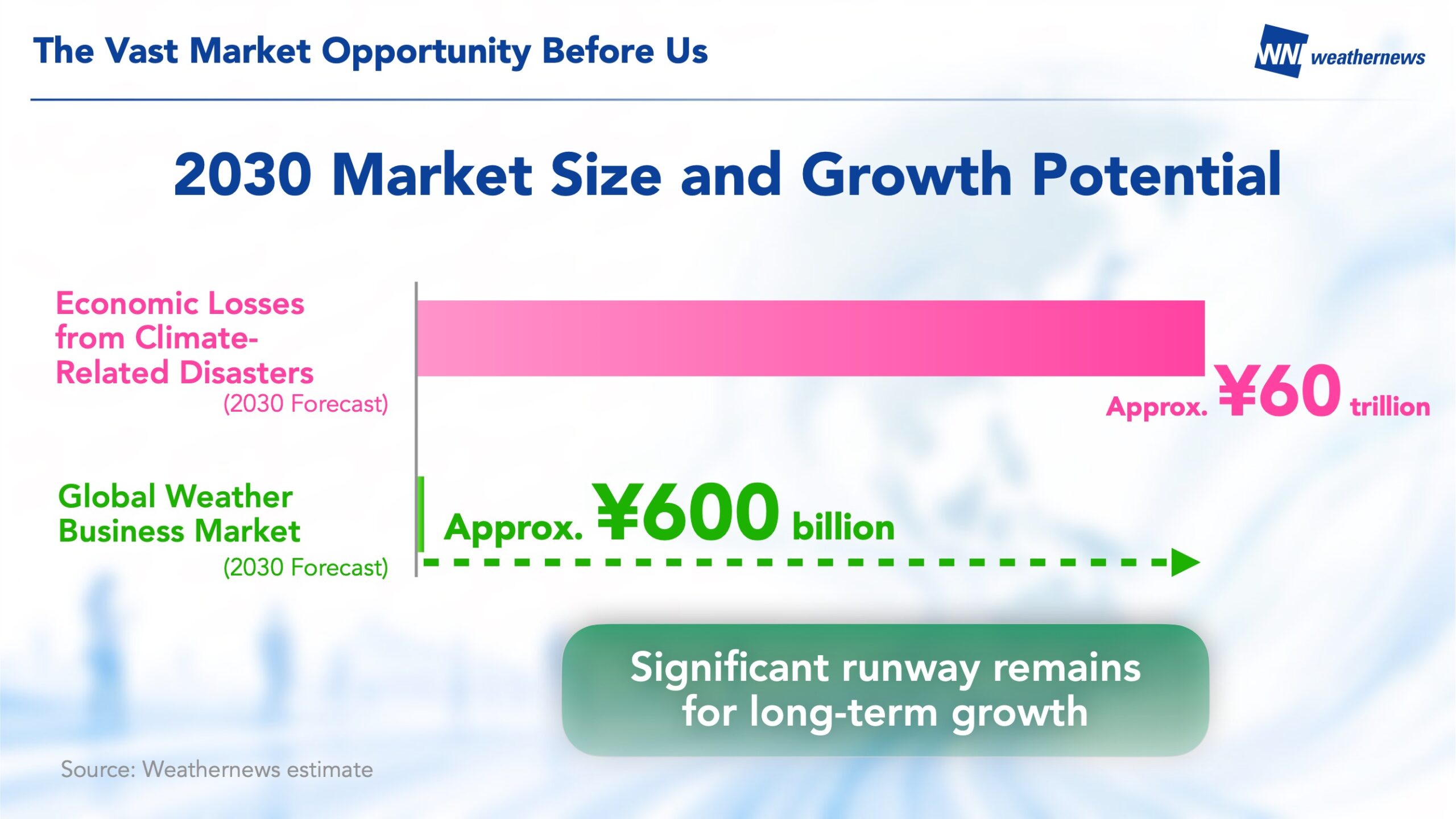
By 2030, the weather market itself is forecast to grow to JPY600 billion, while economic losses associated with climate change are projected to reach JPY60 trillion. So the market we face gives us enormous growth potential. Both the weather industry and Weathernews itself still have a great deal to accomplish.
From here, I will look back over our history.
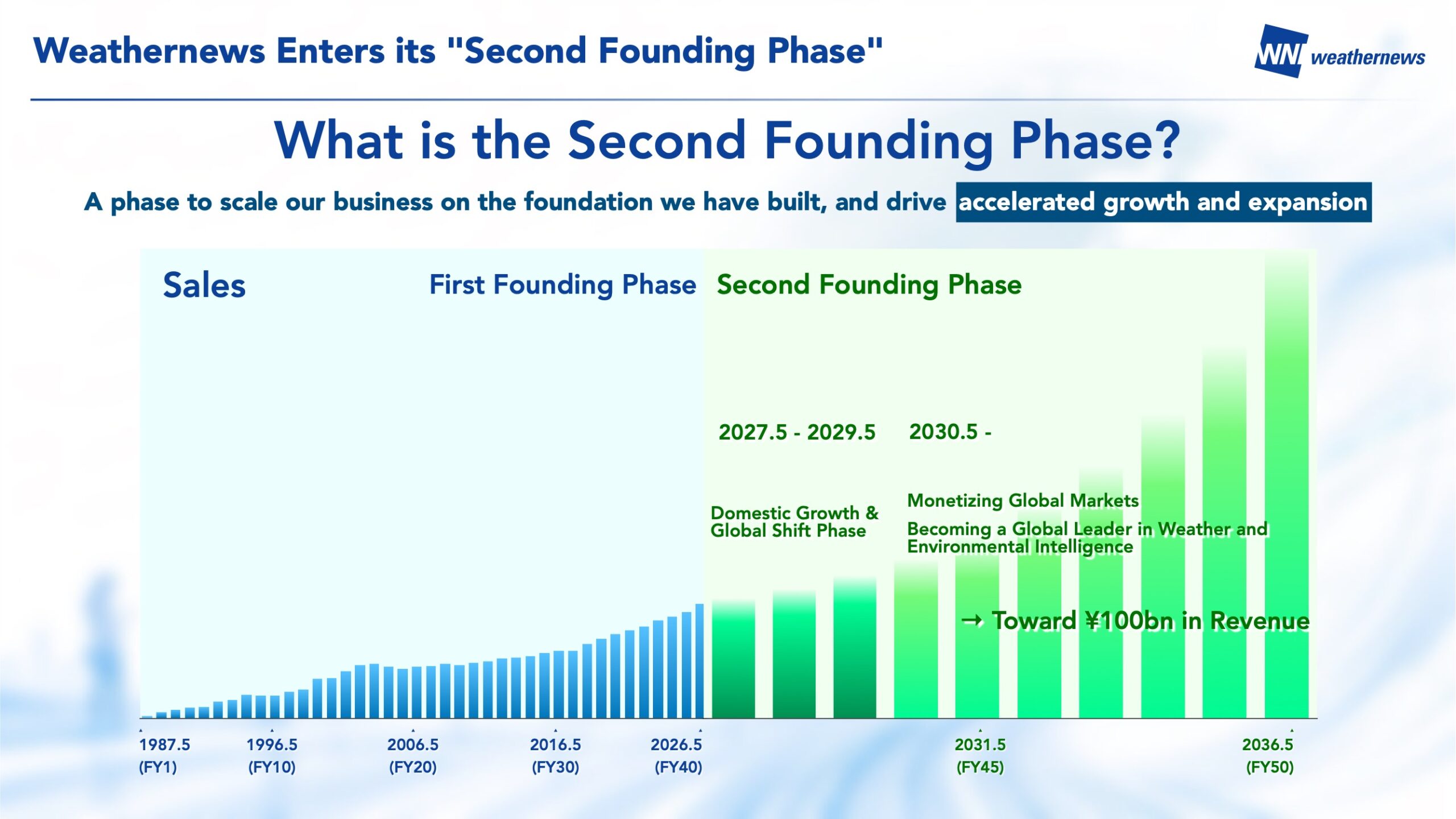
This year marks our 40th anniversary. We now define those first 40 years as our First Founding Phase, and, as the slide shows, we are entering our Second Founding Phase.
During the First Founding Phase, we launched many new businesses from zero to one, put them on a sound footing, and ultimately made them profitable. The Second Founding Phase will be about scaling those businesses.
For the first three years or so, we plan to invest the cash generated by domestic growth in our global expansion. From the third year onward, we intend to scale those operations and monetize them steadily. Our goal is JPY100 billion within 10 years, and we are entering the Second Founding Phase determined to achieve it. I will explain later how we intend to reach JPY100 billion.
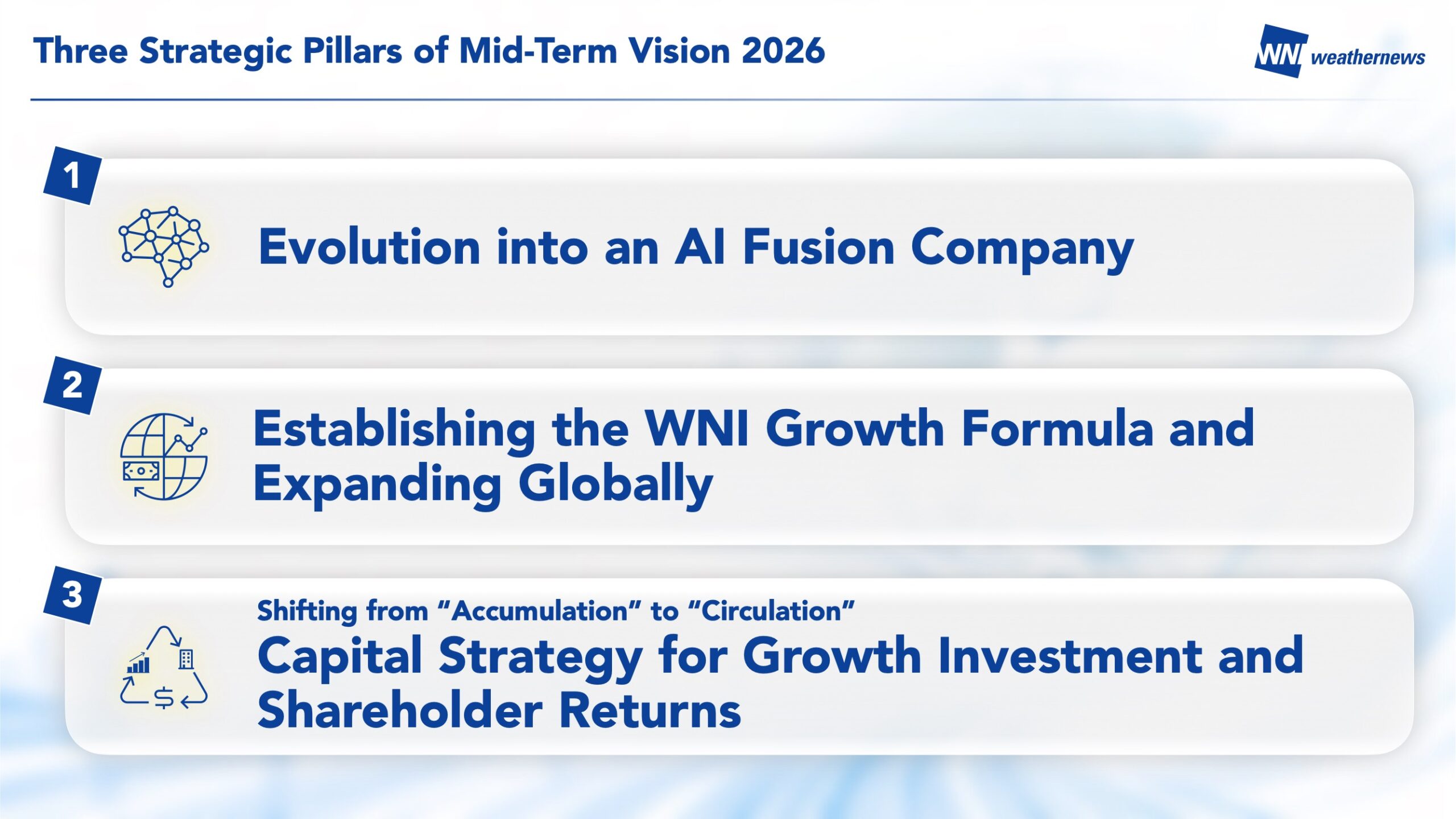
These are the three pillars of our Mid-Term Vision.
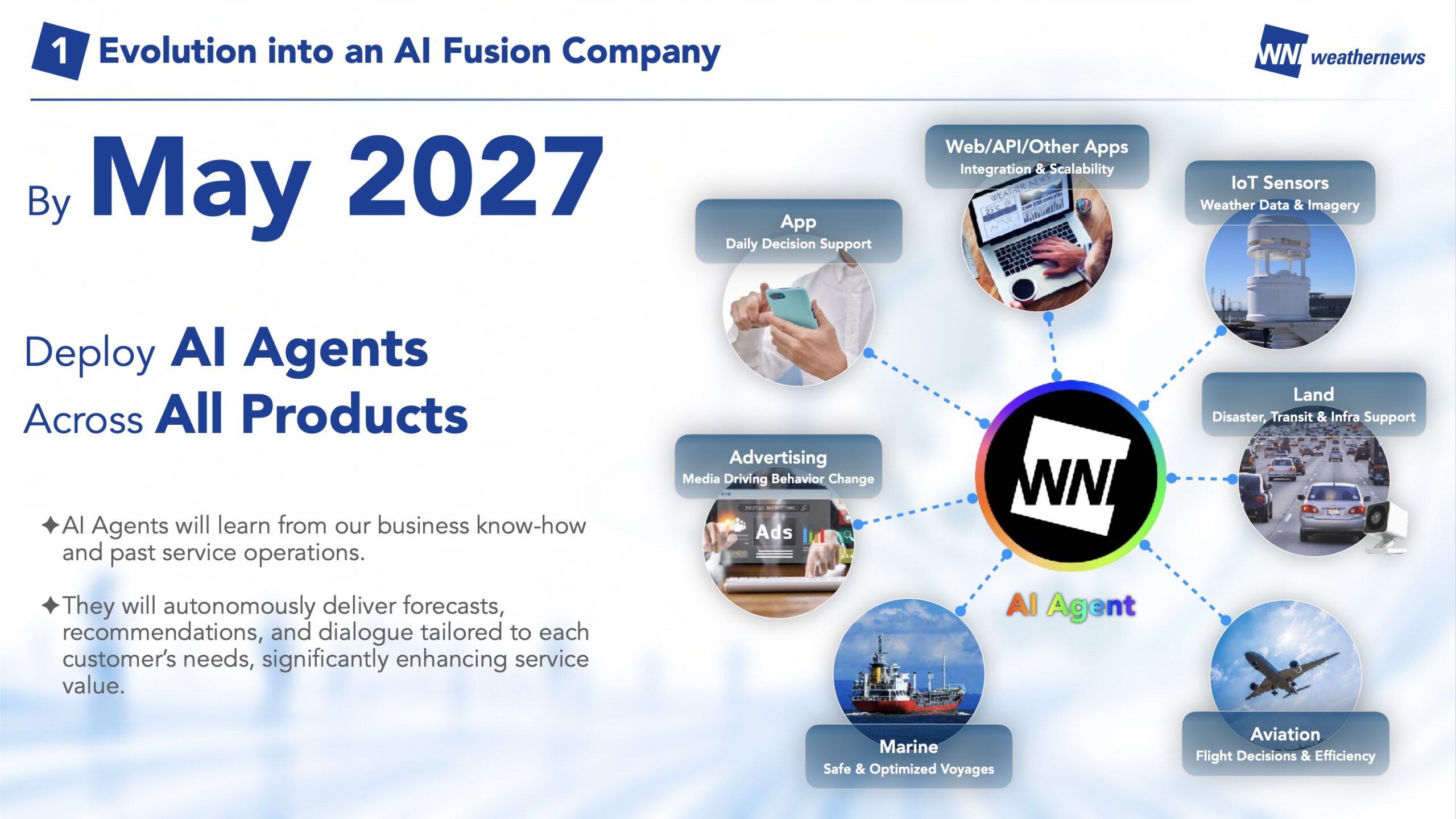
The first is our evolution into an AI Fusion Company and a company-wide transformation.
People say many things about AI, including that it will take people's jobs. Rather than fighting AI, we intend to fuse with it ourselves.
We will integrate AI into our products as well. We plan to embrace AI, use its capabilities to the fullest, and create new value.
By May 2027, during the current fiscal year, we will deploy AI Agents across all of our products.
These will not be simple chatbots that appear in a sidebar. They will be truly autonomous agents, agents worthy of the name. In shipping, for example, an agent would not merely answer questions in a chat window. It would automatically detect when one of a customer's vessels was at risk and automatically alert the captain. That is the type of agent we plan to build into every product.
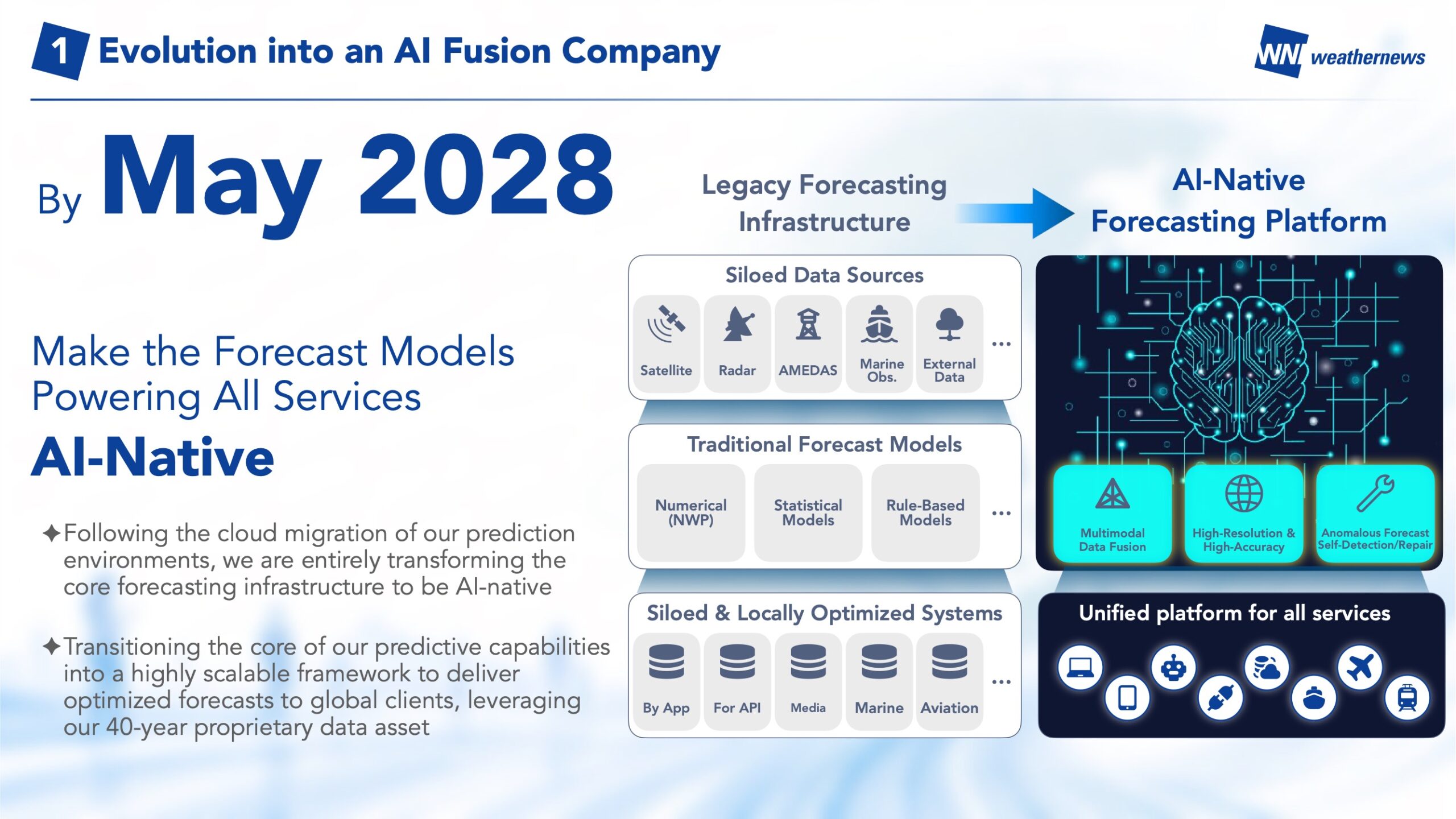
Next, and I think this will be a fairly large undertaking, by May 2028 we will make the core itself AI-native.
Traditional forecasting relied on many data sources and many models, with the data held in separate silos. Making all of that AI-native means using every kind of weather information, including non-numerical observations. This is what the slide calls multimodal: camera imagery and the sound of rain, for example. We will build all of that into an AI-native forecast model and use it to deliver a range of customized forecasts to customers.
AI is particularly good at improving resolution and accuracy. It can also revise its own forecasts after issuing them, detecting where the model needs adjustment, correcting it, and recalibrating it autonomously. Over the next two years, we plan to build a forecasting model in which AI is fused into the very core of our operations.
In the weather industry, it is generally the national meteorological agencies that lead on forecast models. We, however, will move beyond relying on physical models alone and commit fully to AI, so in weather forecasting I do not think any other company is attempting such a drastic shift on such a short timeline.
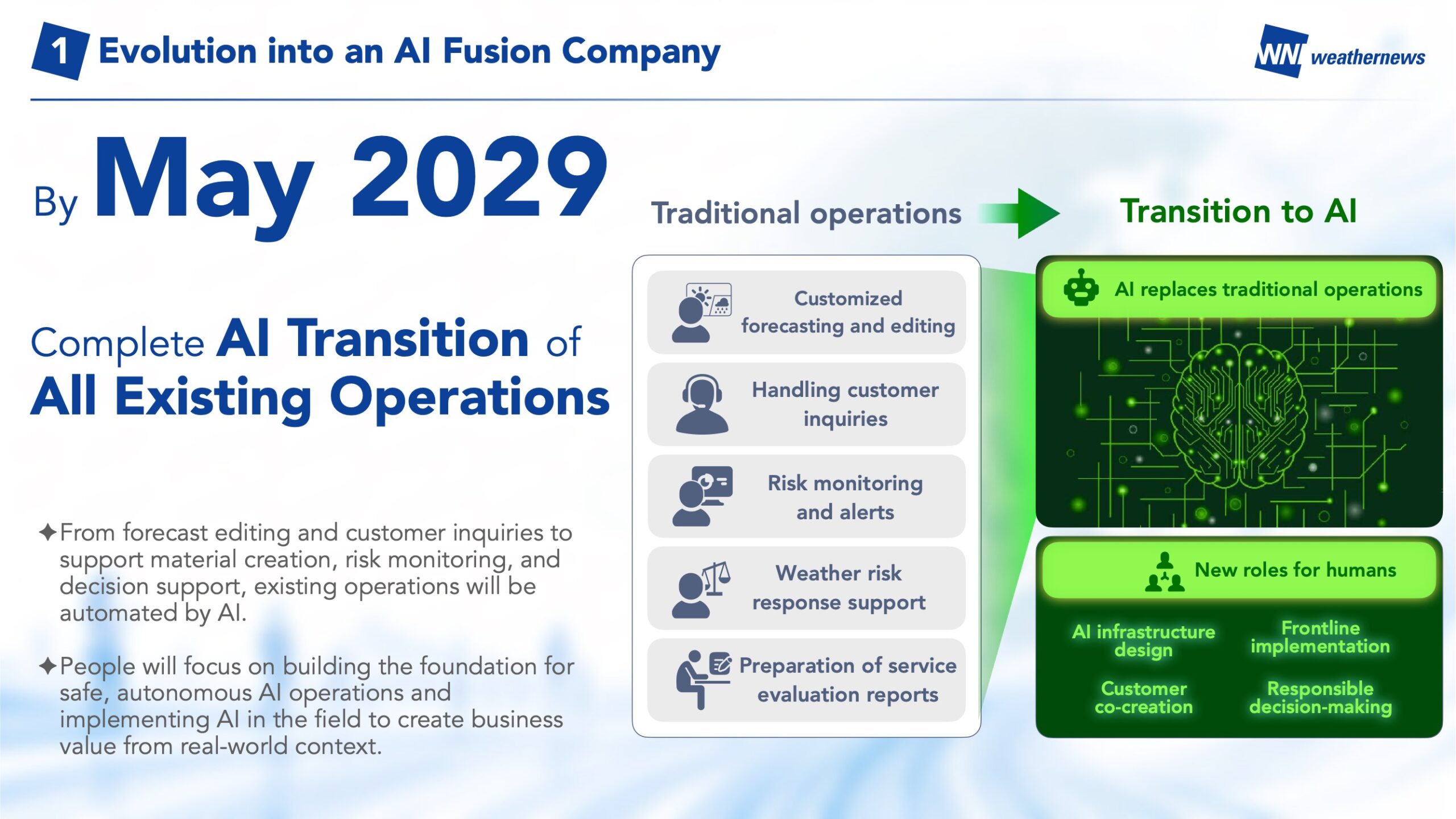
We plan to automate all of our existing operations with AI within three years, and that work is already under way.
We cannot make the change too abruptly. Doing so could disrupt our current operations, which our customers rely on, so we will proceed carefully.
Automation will free up a substantial amount of staff capacity. As shown at the bottom right, employees who currently perform this operational work will instead design the underlying AI infrastructure and control it through what is now called harness engineering. Above all, they will look at where our customers are struggling. Sometimes they will visit the customer's site to learn what is happening on the ground, and feed that back into our products and into the AI. That is the kind of work they will do.
People will retain ultimate responsibility and make the decisions that require human judgment, while we hand more and more of the routine work to AI. On that basis, I expect that within three years AI will handle all of our current operations.
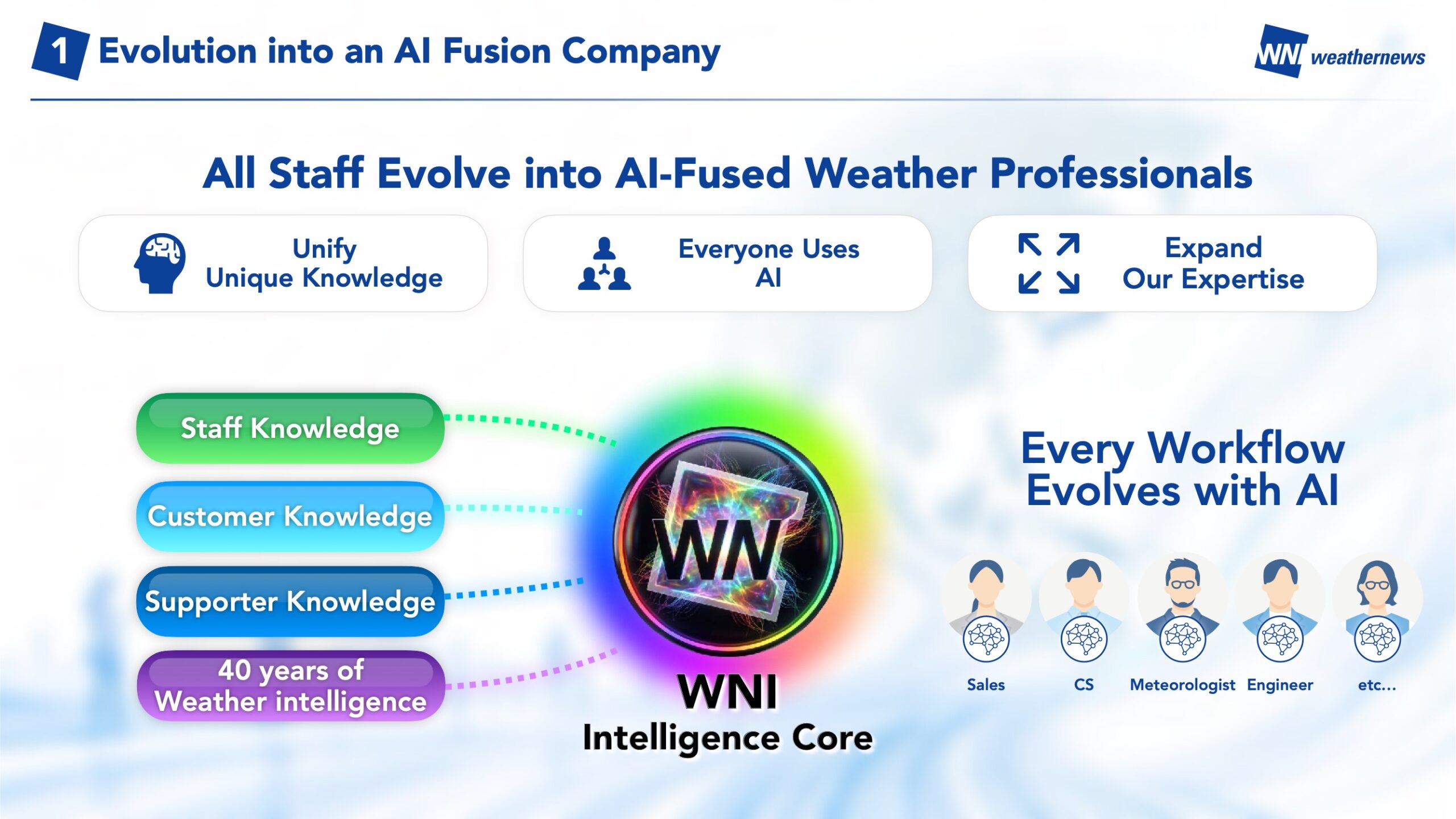
Finally, and this also relates to our investment in people, we have built an internal AI called WNI Intelligence Core.
The Intelligence Core is getting smarter every day. We are feeding it the knowledge our staff have built up, the knowledge our customers and individual supporters carry, and above all the knowledge we have accumulated over 40 years as a weather company. All of that is going into the Intelligence Core right now.
Our staff work alongside this Intelligence Core. In sales, for example, its support lets a single salesperson approach a far wider range of customers, including those they could not reach before, and close deals much faster. AI makes each person more productive.
In customer success, up to now one account manager supporting five or six customers by phone was about the limit. But with AI now handling most of the conversation directly with customers, that kind of world is beginning to emerge, so one customer-success person could eventually support 30, 100, or even 1,000 customers.
Meteorologists will be able to draw on ever greater creativity to produce all kinds of highly detailed forecasts, pinpoint forecasts, and business forecasts.
AI will enhance the capabilities of employees across the Company, from engineers to back-office staff, so that together with the Intelligence Core they can accomplish things no one person could ever have done alone. That is the kind of world I hope we can build.
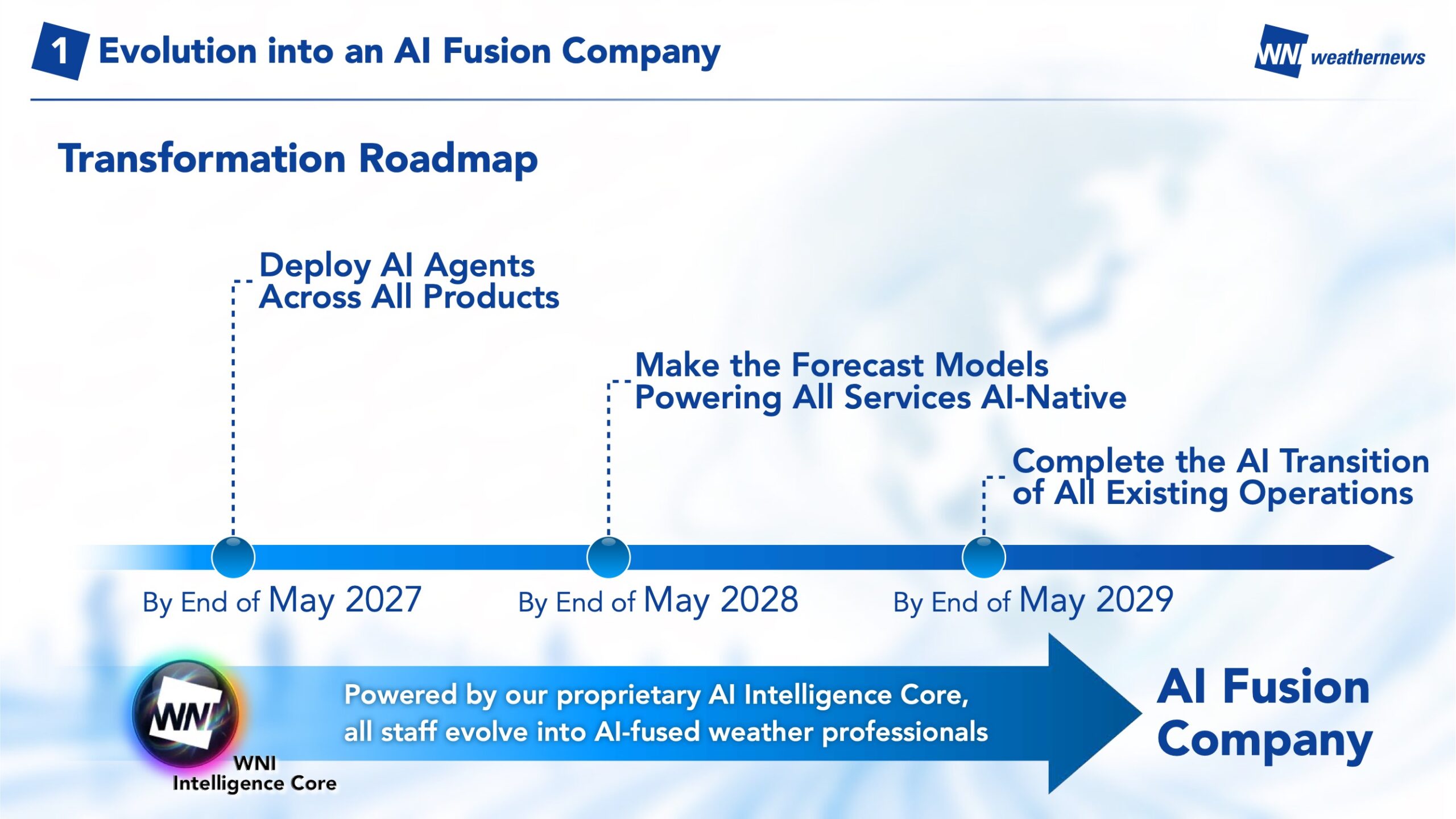
To summarize, this is our transformation roadmap.
Each year marks the next step: deploying AI Agents, making our systems AI-native, and then migrating our existing operations to AI.
Our staff have already begun working alongside the Intelligence Core, and that will steadily deepen. Ultimately, we envision every member of staff fully fusing with AI as we transform into a team of weather professionals.
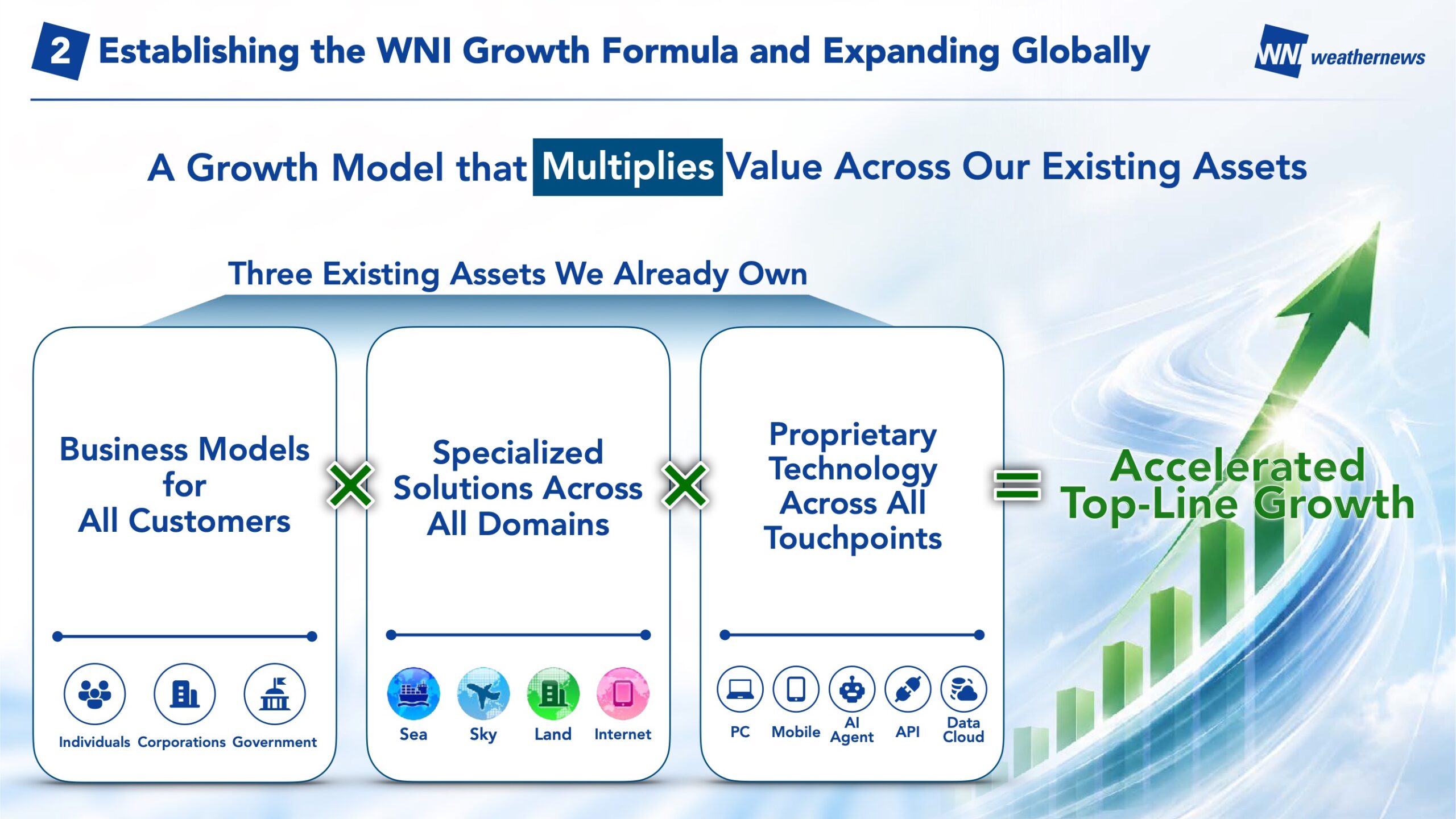
The second is establishing the WNI Growth Formula and, beyond that, expanding globally. Those are the key themes.
Even among weather companies, I think our combination of market position and assets is highly unique.
Consider the business models we use for different customer groups. In the consumer business, we have built up expertise in both subscriptions and advertising: how to convert users into paying subscribers, how to raise ad rates, and how to raise page views. We have all of that know-how built up.
On the corporate side as well, we run a range of consulting and other businesses. And for government, including local authorities, the question is how to secure the budget we need in order to contribute.
Each customer group has its own business model, and we operate across all of them.
By industry, we provide a range of services across four domains: land, sea, sky, and internet.
And we have built every delivery channel ourselves, whether the content reaches customers by PC, smartphone, agent, or API, or as a data feed. So the delivery technology is proprietary to us as well.
What I think sets us apart is our ability to combine these assets and services to accelerate top-line growth.
For example, take one land domain customer, say a railway operator. We already provide various corporate services to them, but another department at that same customer may face a different problem: when the summer gets hot, people stop riding the trains.
If they want to run a campaign encouraging people to head somewhere cool, to a summer retreat, and to ride the trains and enjoy themselves more, our internet domain can support it with advertising. That is exactly what we are supporting right now through the Hisho Tabi campaign. That is one example of the cross-domain work we do.
Of course, a corporate service need not be limited to an operator viewing it on a PC at the control center. If the customer wants every field engineer, the people actually working in the field, to see it too, we can show it on a smartphone.
If they want to make their own internal AI Agent smarter, or to talk with the Weathernews agent, we can also provide our agent as a service.
Our ability to combine our various assets in these ways is what I think is very distinctive about us. Conditions in Japan in particular are quite favorable, so over the next three years what we want to do is establish this firmly as the Weathernews growth model, our service model, and then take it global.
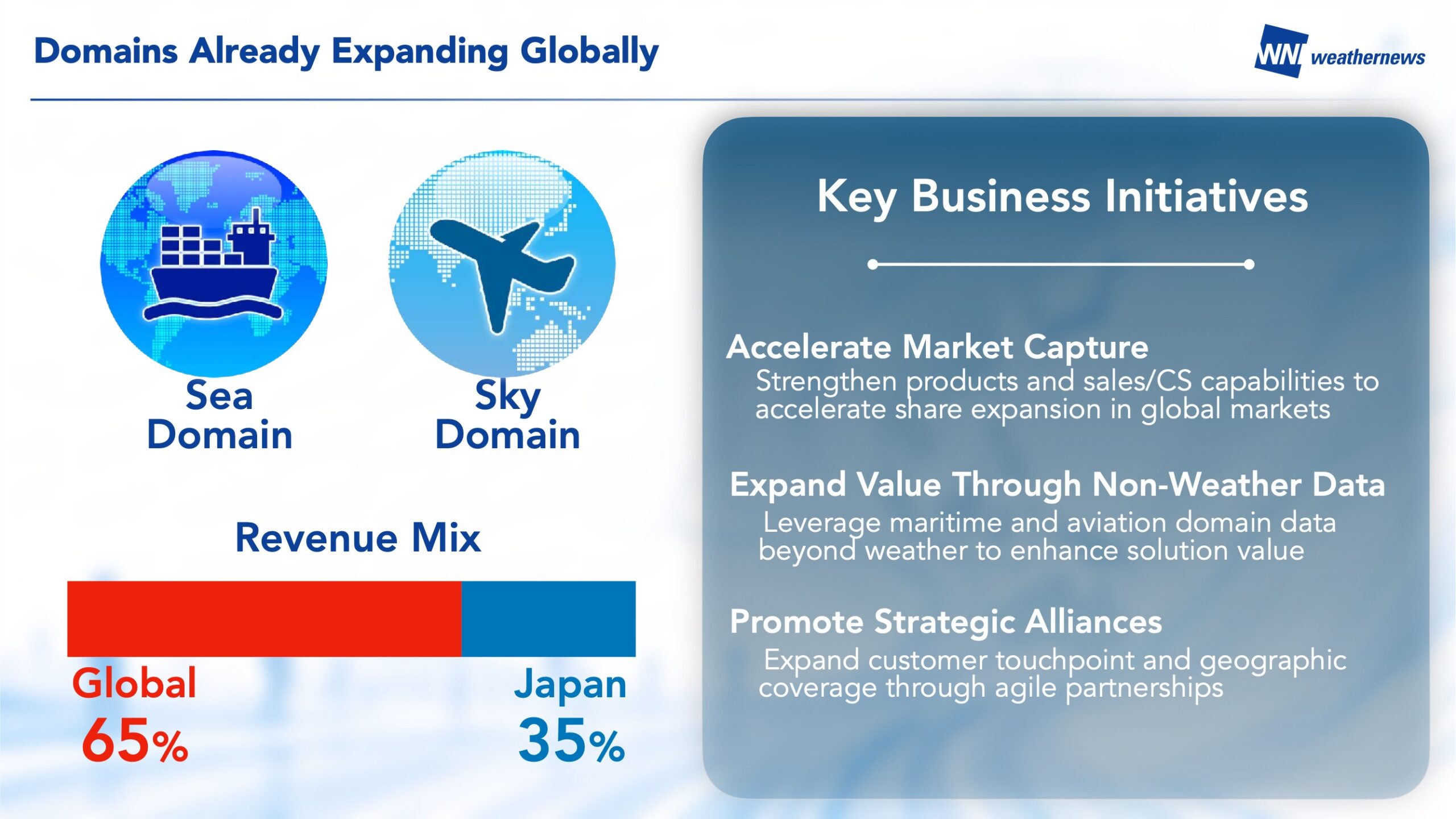
For global expansion, we have divided our businesses into two groups: those that already operate globally and those that do not.
Sea and sky already generate 65% of their revenue outside Japan.
Those two domains therefore already have a global foundation, though both markets have a fair number of competitors.
First, we build out the products, and then we build effective global sales and customer-success organizations. That is one key point.
On top of that, in the shipping world our core is weather data, marine weather and aviation weather. But combining that with things like vessel or aircraft position data, or performance data, opens up all kinds of services. So rather than confining ourselves to weather data, buying external and adjacent data and forming partnerships to combine those with our own becomes another important priority.
Alliances are also a very important priority. I will go into M&A in detail later, and I will pick that up there as well.
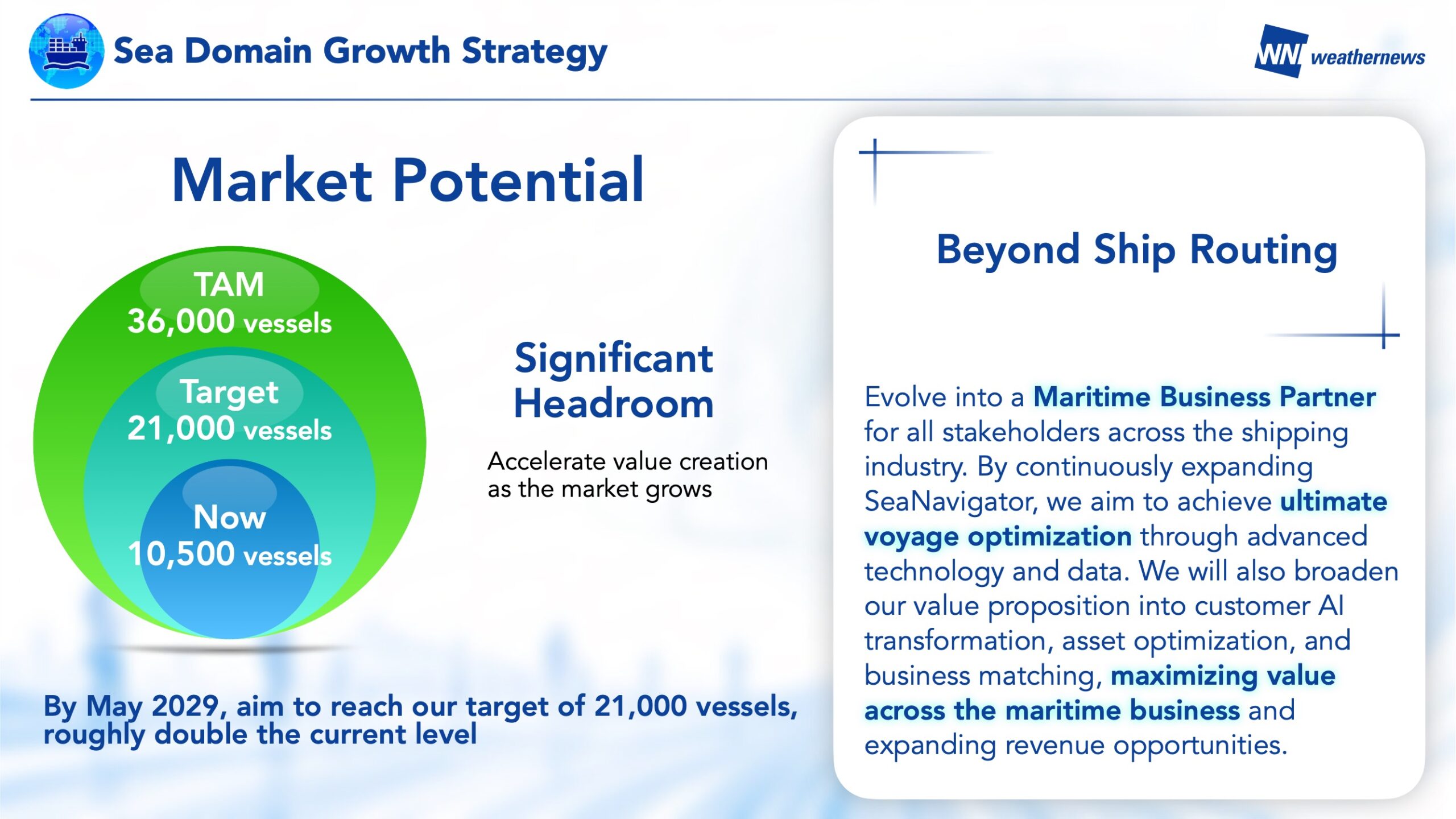
First, the sea domain.
The potential is shown on the left. Somewhere along the way, the market came to see us as a company that does ship routing.
But from here we are moving beyond being a routing company. Rather than routing alone, we see ourselves as a Maritime Business Partner.
We currently serve 10,500 vessels. Over the next three years we intend to double that number while also raising the price per service, growing on both fronts.
Simply doubling revenue is part of it, of course, but that alone will not get us to JPY100 billion. So rather than charging for routing on every customer vessel, we are looking at higher value-added offerings, on the premise that we still do the routing: supporting customers' AI transformation, helping them make better use of their assets, working out where to send a vessel to earn the most revenue, and so on. We are looking at ways to raise revenue in a number of places.
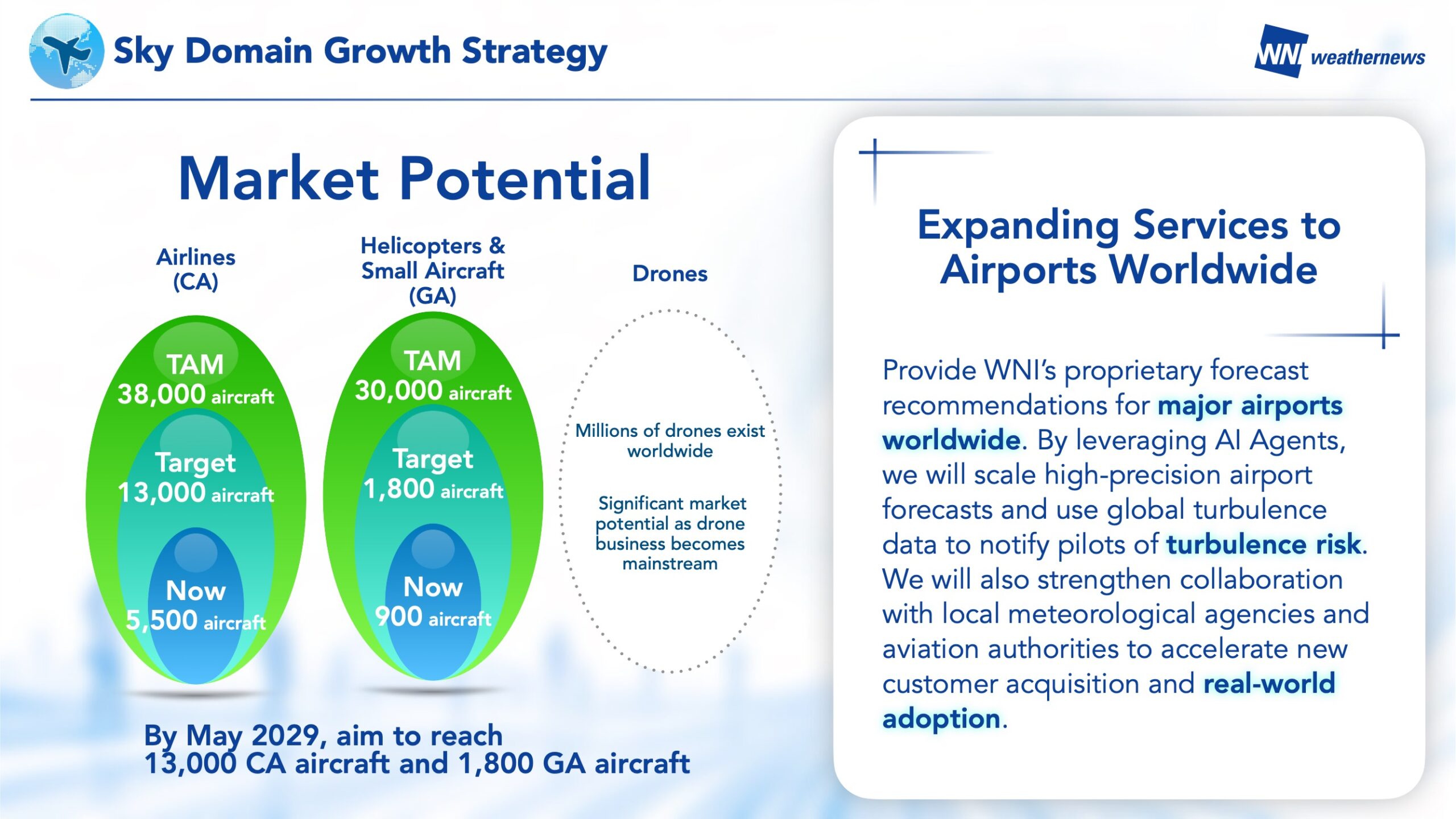
Next, the sky domain.
Sky still has plenty of potential too. At the moment we are focused mainly on Japan and Asia, but we will expand this globally, to airports worldwide. And it goes beyond whether or not the airplane can fly: once it is airborne there is turbulence risk and so on, so that is the direction we want to take.
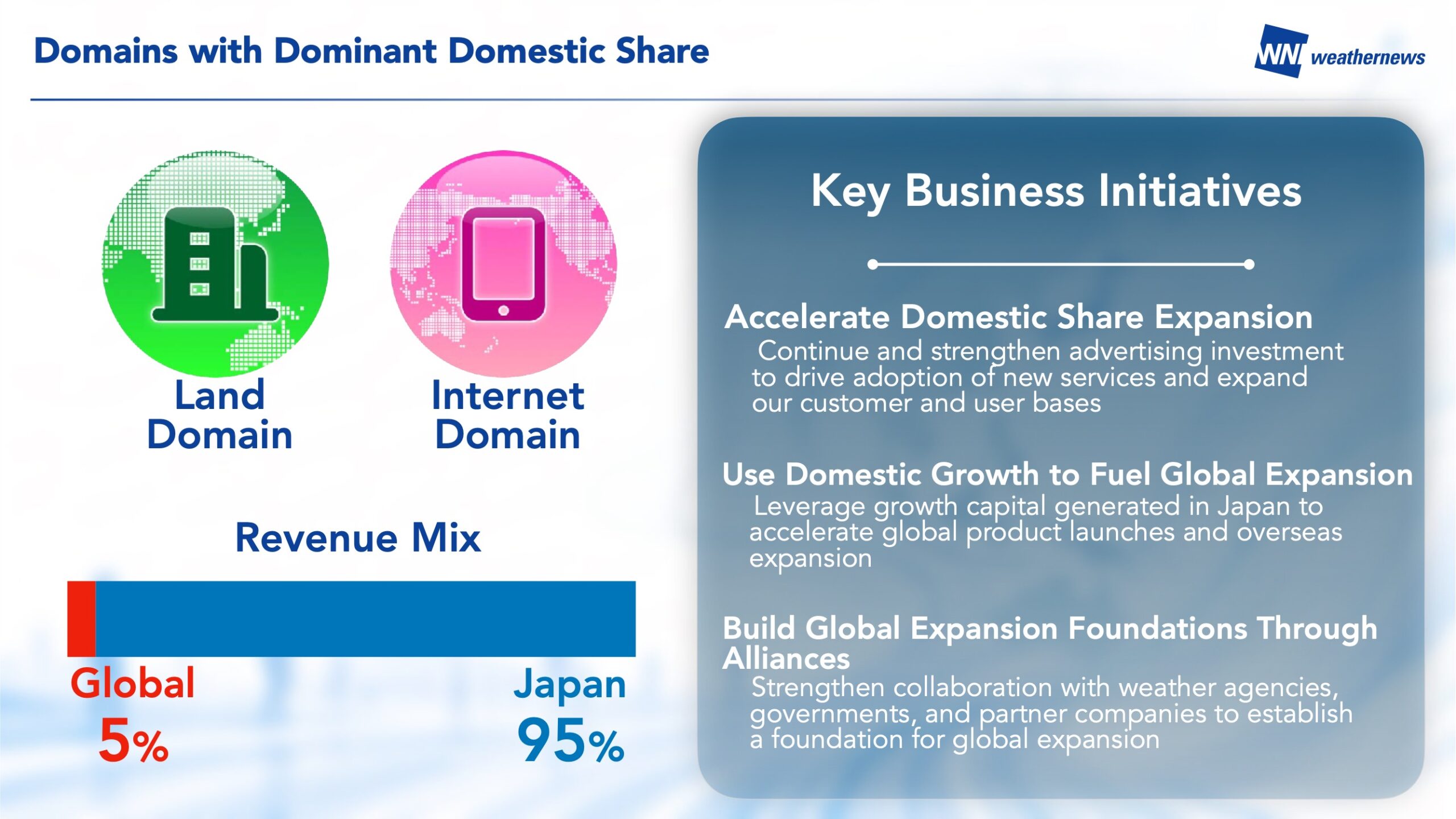
Here are land and internet. As you can see, almost all of the revenue is still in Japan.
These businesses have considerable room to go global. For both domains, however, the first step is to expand our share in Japan, where there is still room to grow if we invest in advertising and the like.
In land, for example, we recently discovered that there is in fact a market for safety confirmation, so I think there is still plenty of opportunity here.
My point is that we use the growth and cash we generate in Japan to fund our future global expansion. Japan is, in a sense, our cash cow. And for land and internet, alliances and relationships with meteorological agencies become very important, and there is a legal dimension too, so working through all of that properly is, I think, the key to driving these businesses forward.
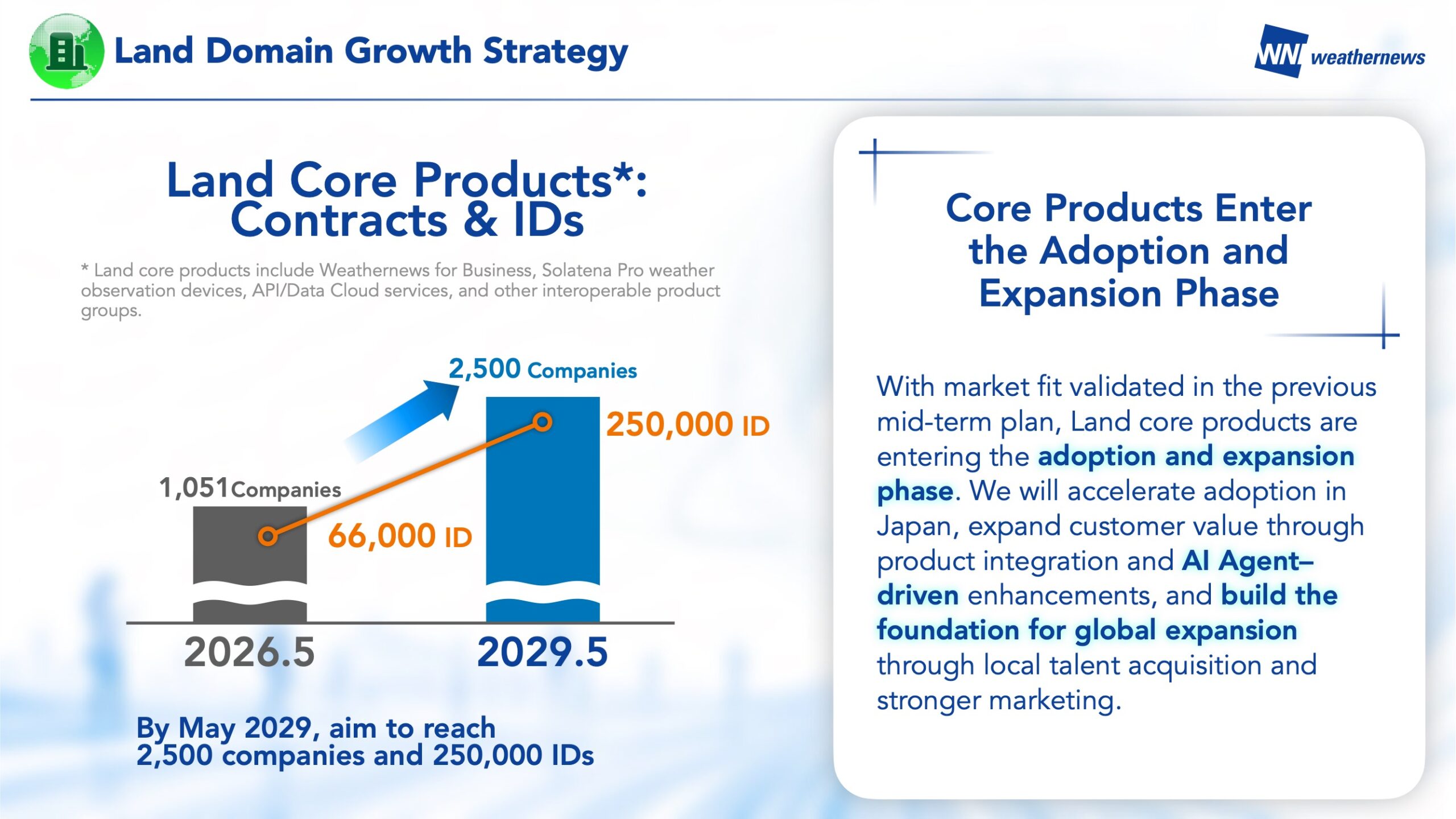
Now the land domain.
Here we have newly defined what we call land core products. Up to now we ran these under the WxTech series. We have now defined Weathernews for business, the Soratena Pro weather observation device, and our data services as land core products.
At this point we believe these products have already achieved product-market fit, so the question from here is no longer initial adoption but how we drive broad uptake, and then how we expand the business. So I see this as a phase where we invest aggressively in advertising and drive the current products into much wider use.
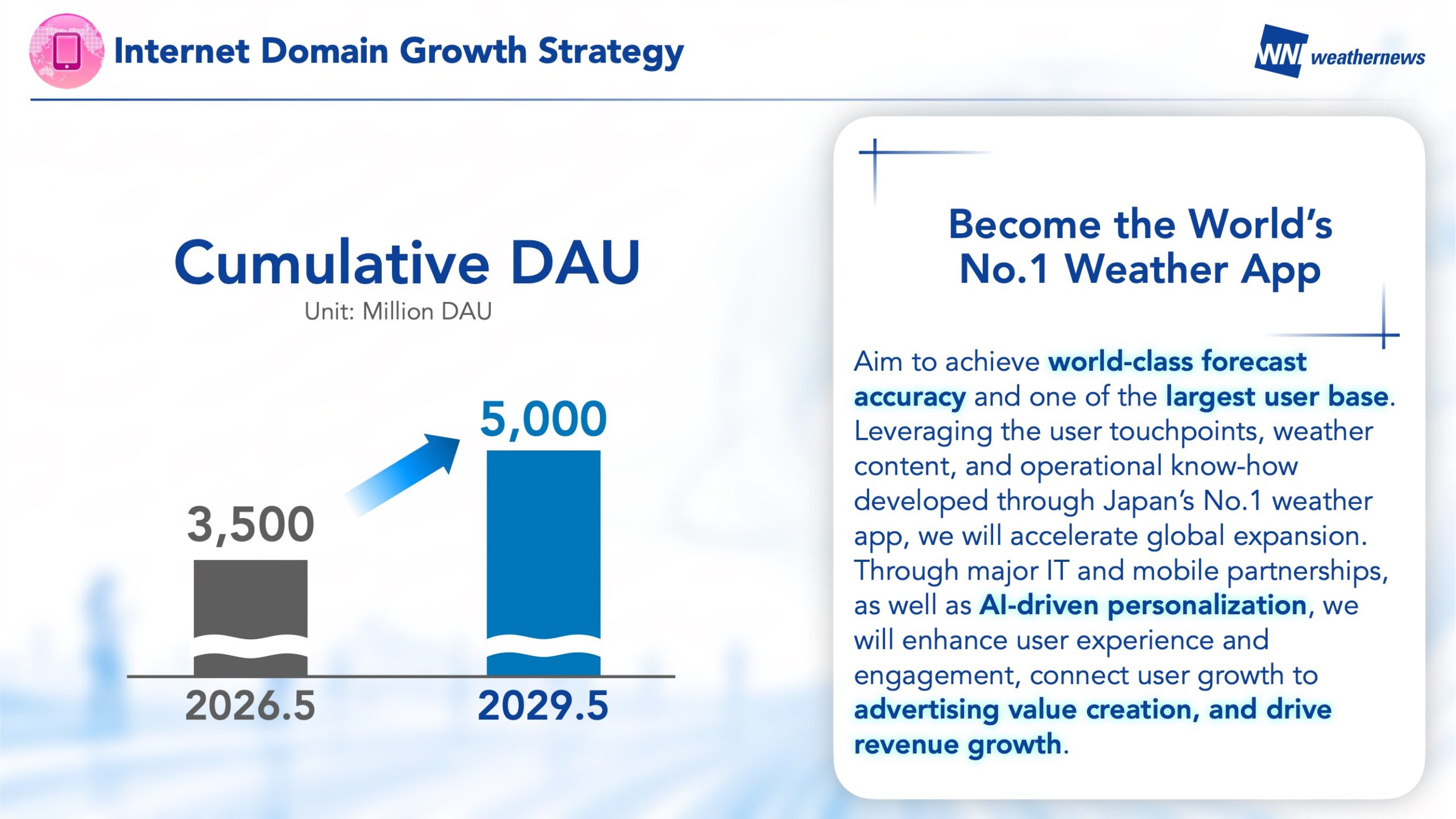
Now the internet domain.
As shown on the right, I do think Japan will keep growing, for the next three years or so. At the same time, I think now is the time to expand beyond Japan rather than stay within it.
So, as it says here, the world's number one weather app. We have looked at many overseas weather apps, and over the past five years or so there has been surprisingly little innovation. In most countries there is a weather app that ranks first, but there is no weather app that ranks first worldwide.
We have developed superior forecast accuracy in Japan, along with the know-how to grow user numbers and to scale advertising. If we apply those strengths and become the world's number one app, then I think JPY100 billion is by no means a dream. So I think this is going to be a very interesting market from here.
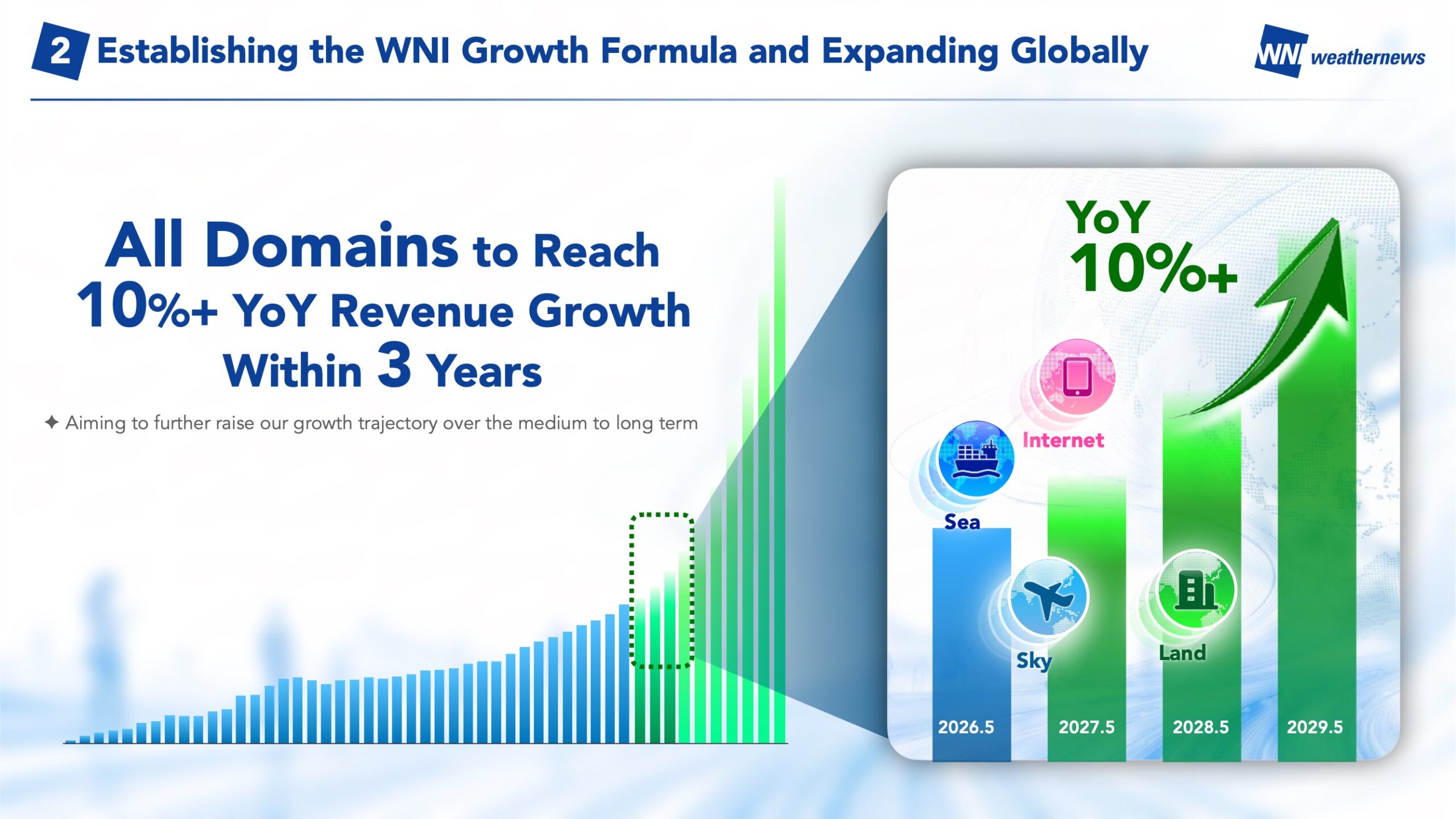
One of our targets is for every domain to reach YoY revenue growth of 10% or more within three years.
So growth may be around 5% or 7% in the first year or two, but in the third year we want every domain to reach 10% and gain momentum. If growth then accelerates to 12%, 14%, and 18%, we would exceed JPY100 billion within 10 years.
We first need to establish a firm 10% growth trajectory and then accelerate beyond it. That requires us to capture global markets, so we must prepare carefully. Our Japanese business is in a strong position and generates ample cash, and I think using those resources to compete globally will be one of our most important priorities over the next three years.

Last, let me turn to capital strategy.
Until now, we have built up a certain amount of capital in preparation for our next stage of growth, for the challenges ahead. From here, we intend to put that capital to work and create a cycle of reinvestment.
In order of priority, we first invest and grow the top line. Within that, where we can form alliances, we will consider them, including M&A. Doing that while also raising the dividend in a balanced way is the concept behind shifting from accumulation to circulation.
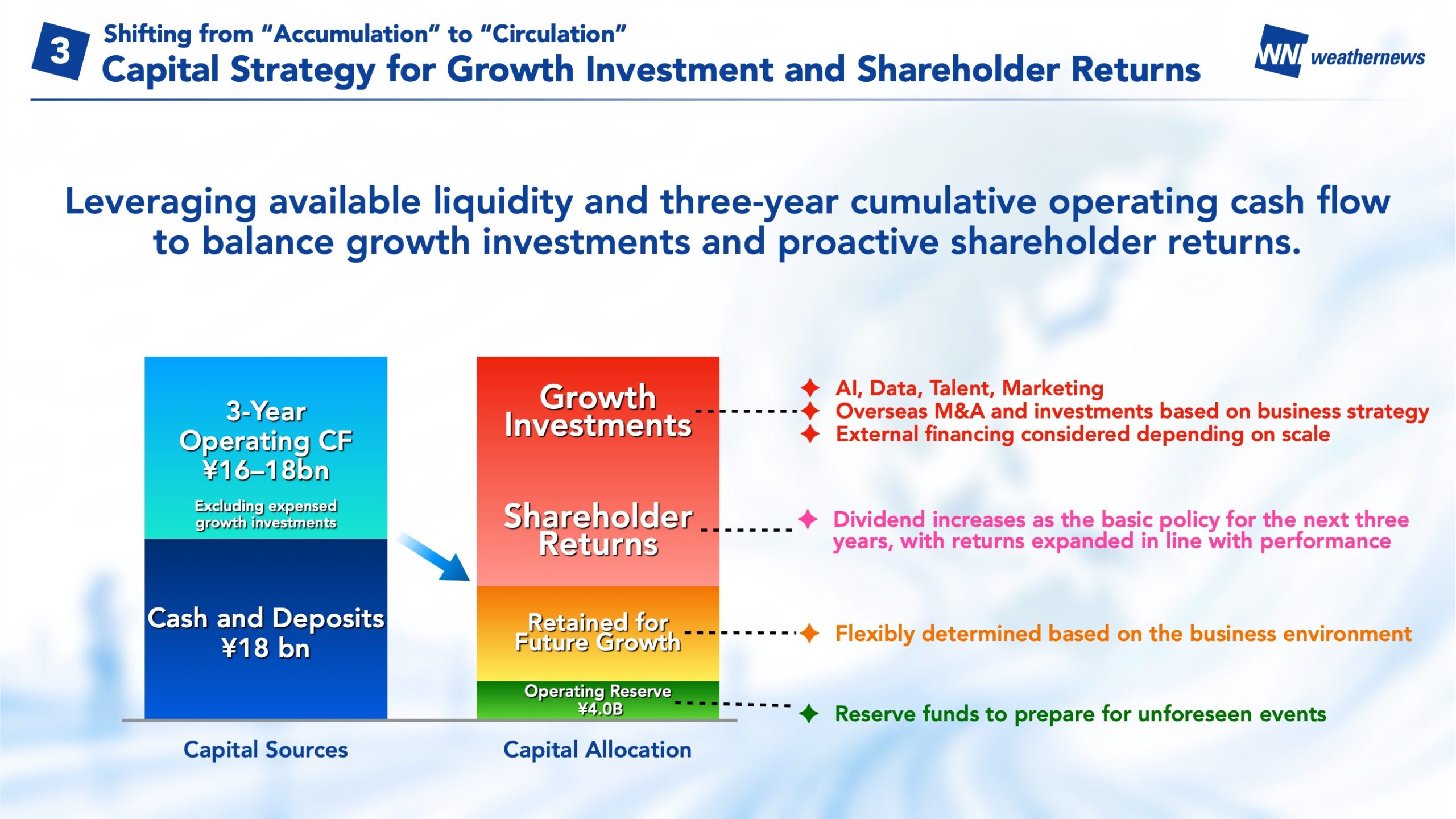
This shows our cash flow allocation.
Cash and deposits currently stand at around JPY18.8 billion, based on the latest figures, I believe. Over these three years I expect operating cash flow to come to around JPY16 billion to JPY18 billion, and we plan to direct most of that to growth investment and shareholder returns. The downward arrow from cash and deposits is deliberate: even if it means drawing down cash, we will invest, pay dividends, and keep capital moving through the business.
We believe about JPY4 billion is enough to keep the Company running properly if something happens, so we will keep that minimum buffer in place while shifting the rest from accumulation to circulation.
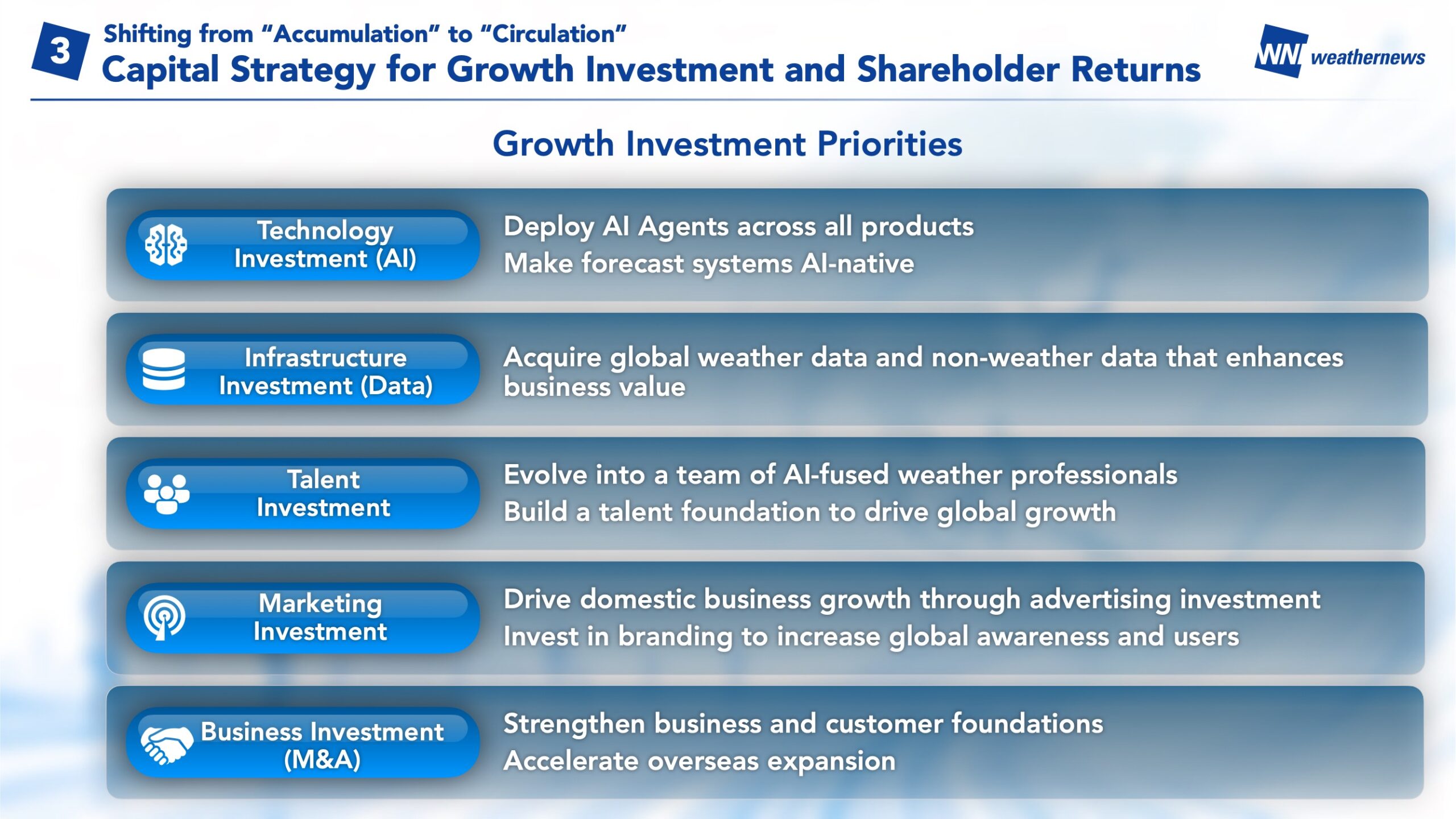
The slide lists our priority areas for investment.
We will of course invest in AI. We will likely buy data. We will invest properly in infrastructure. On talent, we will invest in fusing with AI, and if we go global, there will also be investment in putting sales and customer-success people in place. We will of course invest in marketing too. As for M&A, I will explain that next.
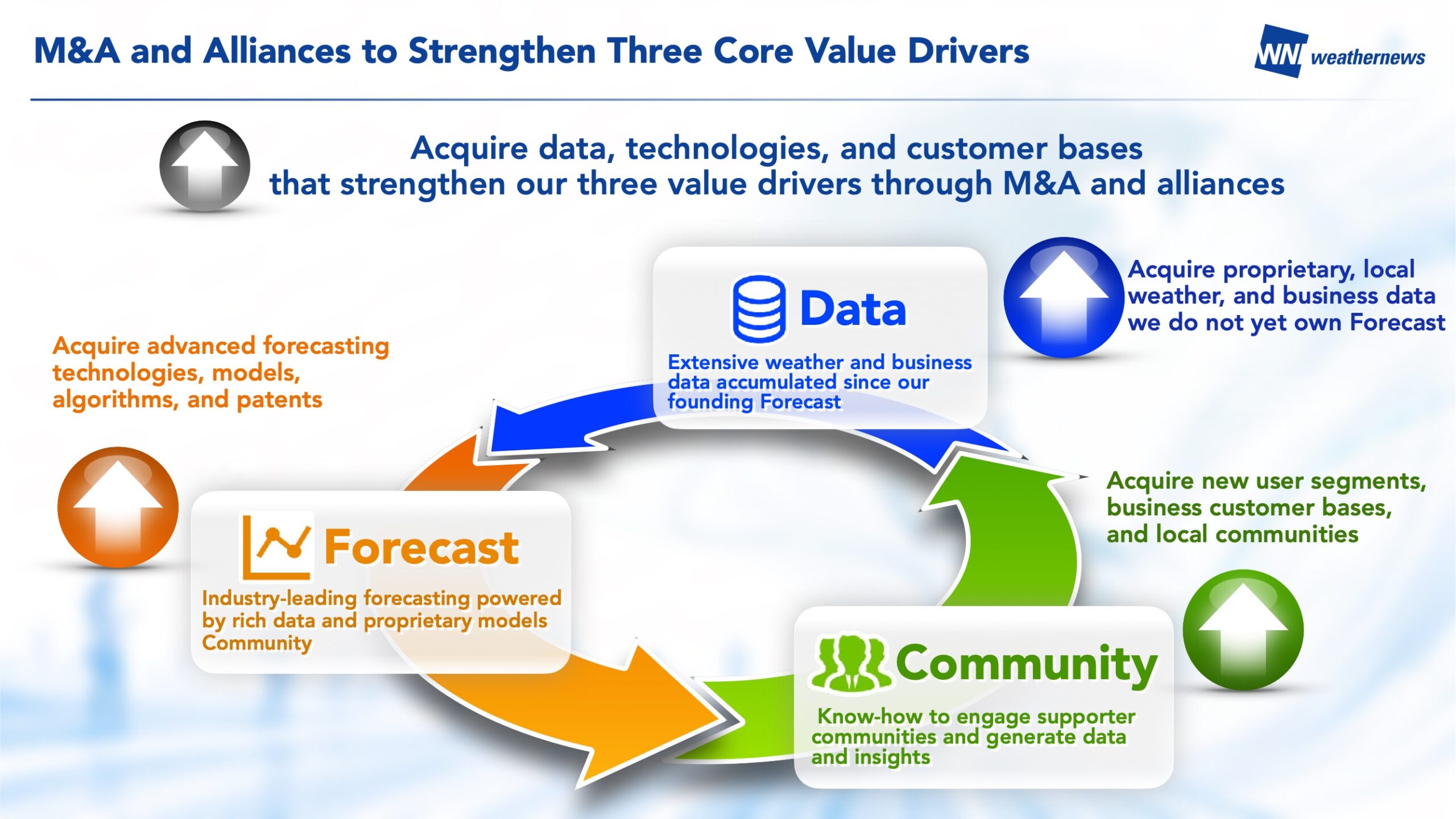
Let me explain the kinds of companies we might work with through M&A.
Fundamentally, this comes back to the strengths I have described throughout. With Data we can produce a good Forecast, a good Forecast draws people in, and the Community that forms feeds still more Data backup.
That is our cycle. Anything that complements or strengthens those three strengths, Data, Forecast, and Community, becomes a target for M&A or an alliance.
On data, if there is data we simply cannot obtain ourselves, let us actively pursue alliances.
There are probably few forecasts we cannot produce ourselves, but local markets have all sorts of specialized forecasts, including for markets we have not moved into. Alliances and M&A can help us acquire those capabilities more quickly.
If a company already has a customer Community, we can work with them and bring that Community into this cycle. That is the kind of partnership we have in mind.
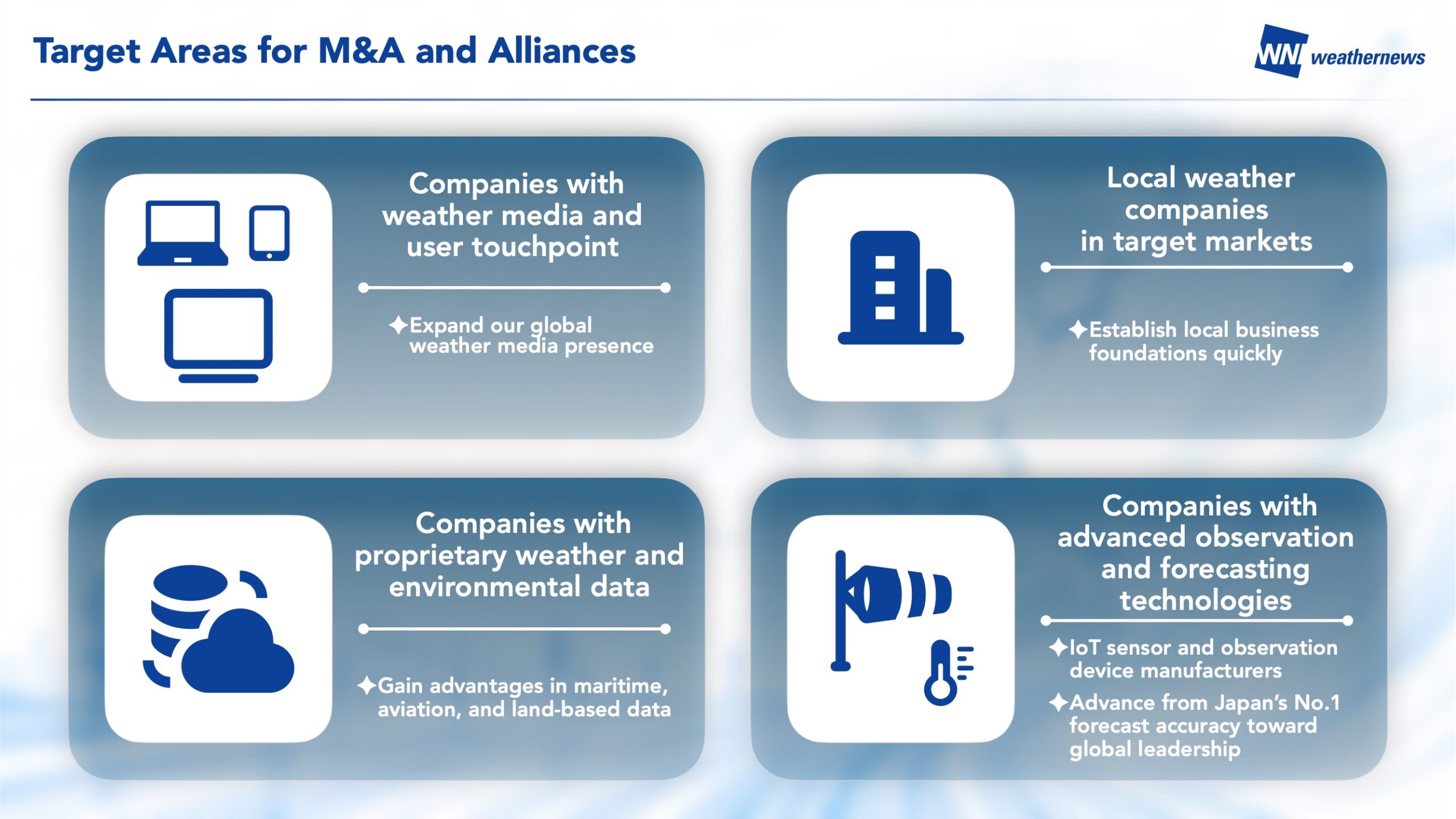
We expect our M&A and alliance targets to be companies that already have weather media, local weather companies providing various services, companies with their own proprietary weather data, and companies with observation or forecasting technologies.
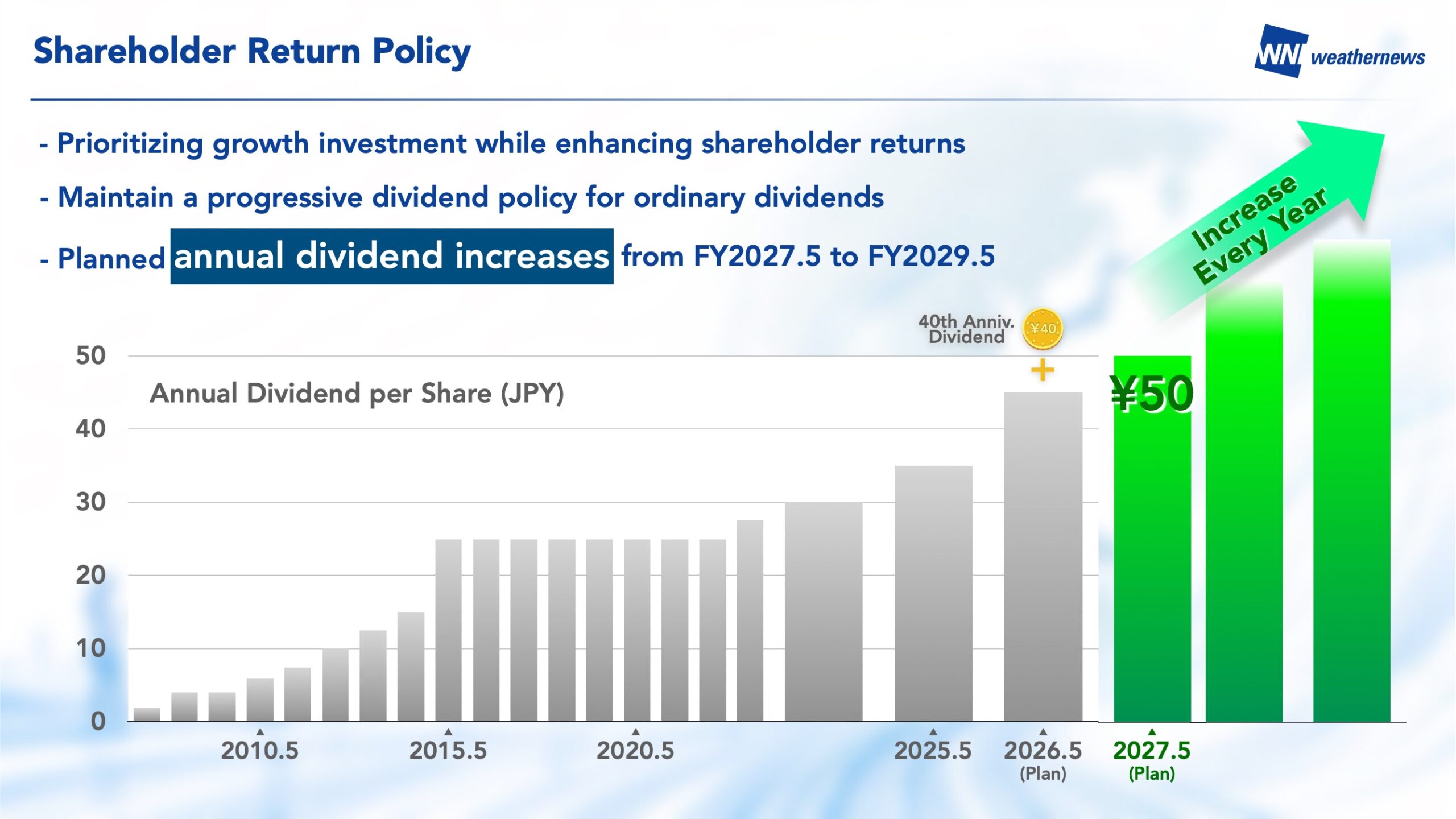
This is our shareholder return policy.
We will maintain a progressive policy for the ordinary dividend and are considering raising it in each of the next three years. We plan an ordinary dividend of JPY50 for the fiscal year ending May 2027, followed by annual increases that stay balanced with our investment needs.
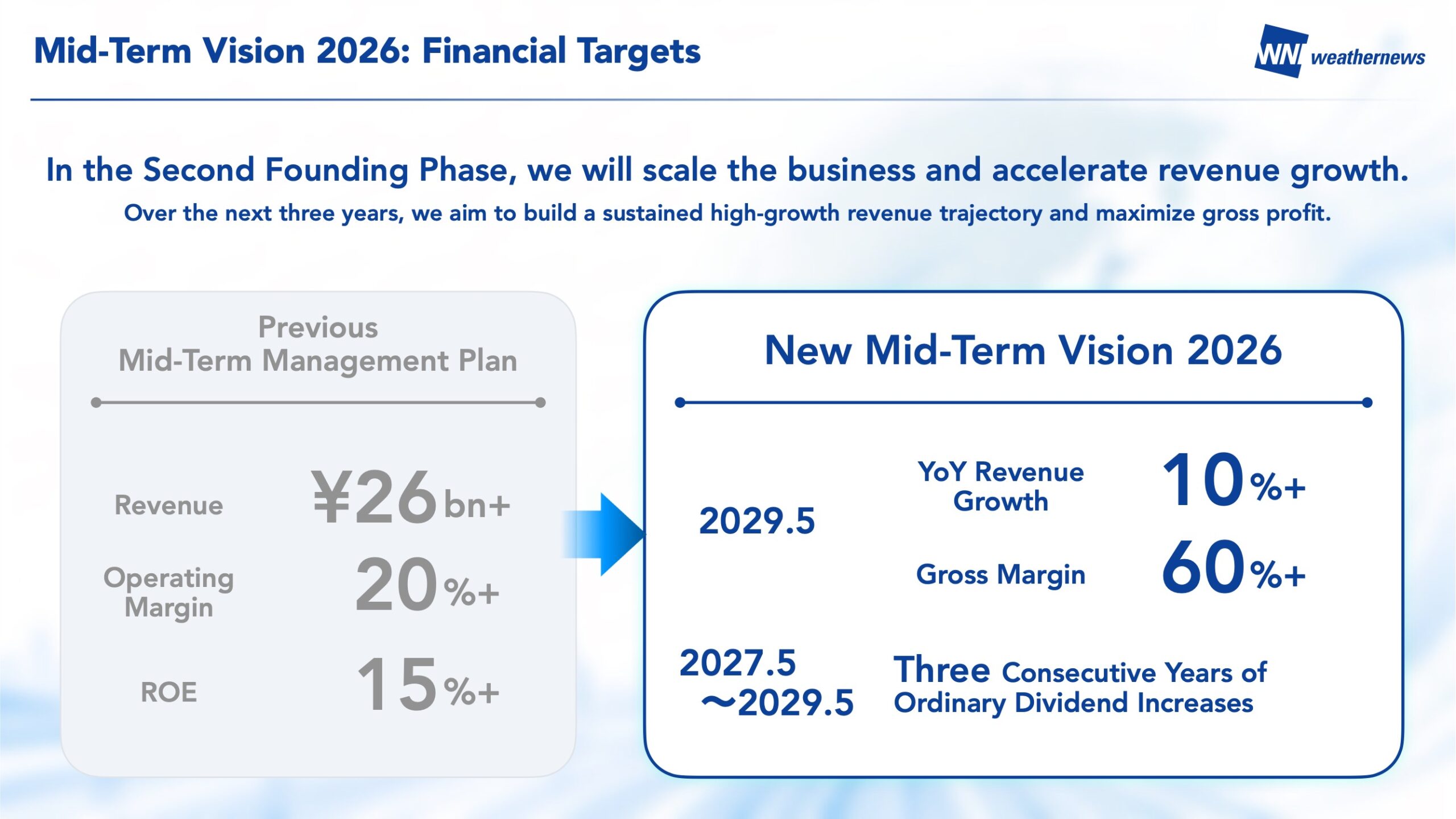
These are the financial targets for Mid-Term Vision 2026.
The targets for three years from now are shown on the right. The previous mid-term plan used revenue, operating profit, and ROE as its indicators. This time, the targets are revenue growth of 10% YoY in the third year, a gross profit margin of around 60% rather than an operating margin, and three consecutive annual dividend increases.
The gross profit margin is currently around 47% to 48%, but I think that with AI we can comfortably raise it to 60%. Those are the final financial targets of Mid-Term Vision 2026.
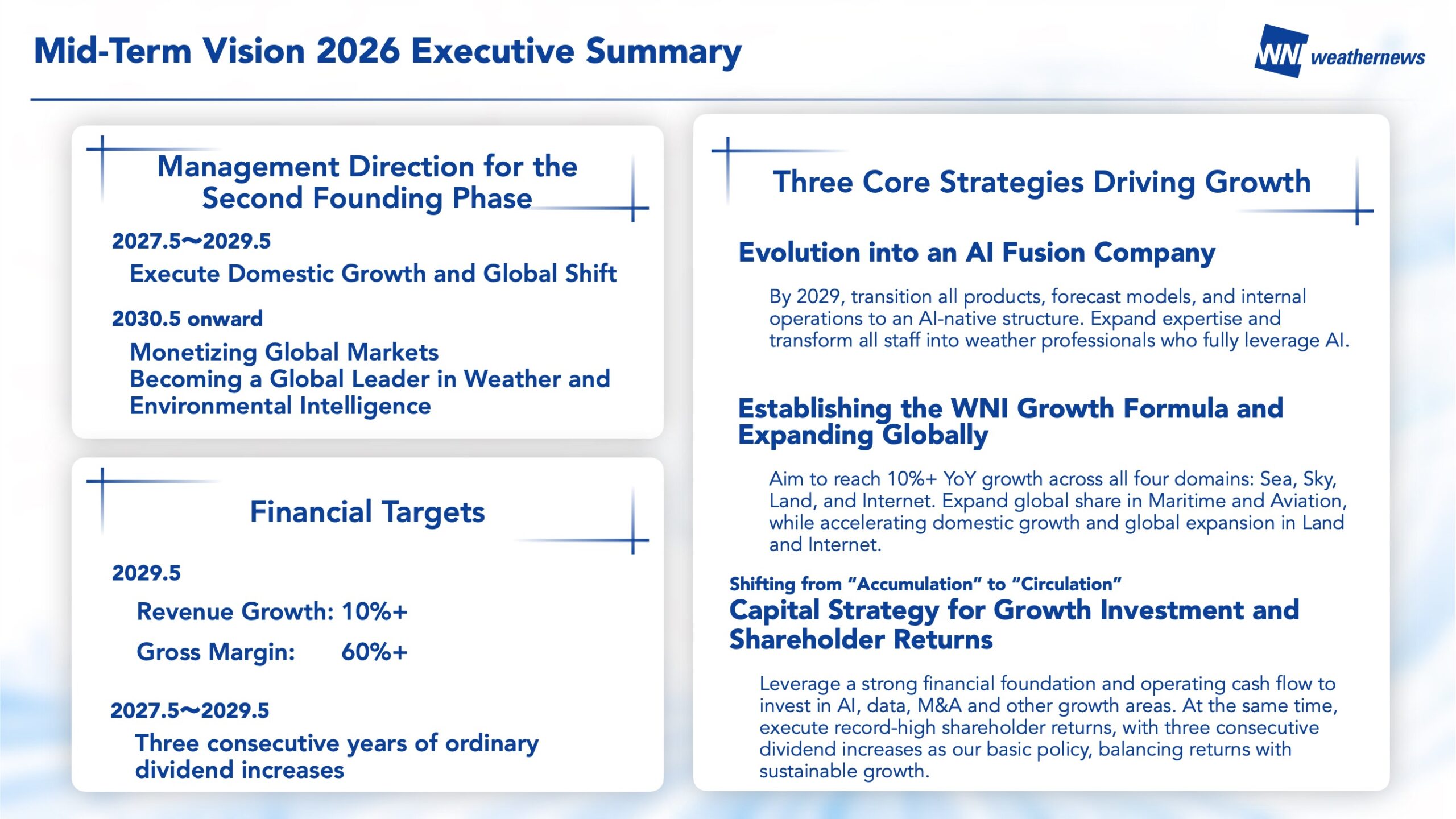
This is the executive summary.
That concludes my explanation of Mid-Term Vision 2026. Thank you very much.
[Q1]:
Why did you change your key financial target from operating margin to a gross margin of 60% or higher?
Ishibashi [A1]:
Under our new Mid-Term Vision, we intend to step up promotion and increase sales promotion expenditures. Operating margin reflects these expenditures, while gross margin does not. We have therefore adopted a gross margin of 60% or higher as a key measure for managing costs. It also demonstrates our intention to invest in the necessary promotional activities while firmly growing our top line.
[Q2]:
How do you expect the four domains to contribute to achieving revenue of ¥100 billion in ten years?
Ishibashi [A2]:
Our basic scenario assumes growth across all four domains: SEA, SKY, LAND and Internet. We are considering several possible scenarios. One of them is that the Internet Domain could achieve a major global breakthrough and develop into a very large business. A more realistic scenario, however, is that the SEA Domain accelerates its progress toward market dominance, while the LAND Domain also delivers significant growth. LAND has considerable potential, particularly in Asia, where the market itself is still underdeveloped despite the increasing economic losses caused by climate change. We therefore expect all four domains to grow, with SEA and LAND making relatively large contributions toward achieving the ¥100 billion revenue target.
[Q3-1]:
Regarding M&A and alliances to support your global expansion, what types of companies and regions are you considering, and what scale of investment do you envisage?
Ishibashi [A3-1]:
Our approach to M&A and alliances differs by domain. From a geographical perspective, however, we expect our primary focus to be outside Japan. In Japan, we have already built up a substantial business foundation and expertise, so in many cases it may be faster for us to develop the business ourselves.
We also believe that the way companies are integrated following an acquisition will change. In previous M&A transactions, each region had its own forecasting staff, sales organization and customer base. The main focus of PMI was therefore how to integrate these independently operated forecasting and sales processes.
Going forward, however, M&A will take place in the AI era. For example, we expect the weather expertise, know-how and customer-related knowledge held by a partner company to be incorporated into the WNI Intelligence Core. This will become a central part of the integration process. AI will play a central role in service delivery and value creation, while relationships with local customers, existing networks and customer success functions will continue to be managed locally. We believe this could become a new form of PMI in the AI era.
In other words, our basic approach is to extend the AI-centered integration of knowledge and operations that we are currently undertaking internally to external partners as well. We therefore expect the nature of M&A itself to change.
The potential investment size varies considerably depending on the target. Many companies in the weather industry are relatively small, so transactions involving these companies may typically be in the low billions of yen. In each case, we will compare whether it is better to work together through M&A or an alliance, or to develop the business independently. Some potential targets, however, could be too large to finance solely with our current cash resources.
In such cases, we may consider alternative financing methods, and we do not necessarily need to acquire 100% of the company. Rather than setting a single fixed M&A budget at this stage, we intend to consider a broad range of options depending on the target and strategic purpose.
[Q3-2]:
For a larger acquisition, would you consider using external financing, including an LBO structure?
Ishibashi [A3-2]:
During our first founding phase, we established the foundations of our business. In this second founding phase, we need to use that foundation to grow the business significantly. If external investors recognize the value of our business model, methods and accumulated know-how, we believe there is sufficient potential to use external financing for a larger acquisition. We have not decided on any specific financing method at this stage, but external capital is certainly one of the options available to us.
[Q3-3]:
Do you have any regional priorities for M&A, such as the United States, Europe or Asia?
Ishibashi [A3-3]:
In principle, regions where we already have offices are more accessible in terms of our existing connections. As we already have offices in various parts of the world, we are not currently prioritizing one specific region over the others. However, looking at our current revenue mix, the United States is a market where our revenue contribution remains relatively low. In that sense, it is a region in which we need to take on a greater challenge.
[Q4]:
What business risks associated with AI are you paying particular attention to?
Ishibashi [A4]:
One risk is how we control AI. As we consolidate our knowledge and data within the WNI Intelligence Core, we need to establish appropriate guardrails to prevent situations in which one customer could access information belonging to another customer. Another potential risk is that the continued development of large-scale AI models could eventually replace the services we currently provide. However, solving each customer’s specific issues requires more than general weather expertise.
It also requires an understanding of their individual workflows, proprietary data and specific business circumstances. We therefore do not believe that large-scale AI models alone will be able to solve every issue. Our role is to use the strengths of these large AI models and combine them with our own expertise and data. This will allow us to extend our services into more detailed areas that we could not previously address and create additional value. It is important not only to view AI as a risk, but also to use it effectively by integrating it with our capabilities.
[Q5-1]:
As you implement your AI roadmap, how do you expect revenue and costs to change?
Ishibashi [A5-1]:
The first stage is the development of AI Agents, which requires investment in creating and enhancing our products. The development of AI-native forecasting models will also require a certain level of investment. The cost transition is similar to what we experienced when moving from on-premises infrastructure to the cloud. During the transition period, the old and new systems operate in parallel, which temporarily results in overlapping costs. Once the transition is complete, however, the systems can be consolidated.
We also gain the benefits of new services and capabilities that are only possible in a cloud environment. We expect the transition to AI to follow a similar pattern, with the composition of our costs changing over time. By contrast, applying AI to existing operational work should lead directly to cost reductions as implementation progresses. Over the past two years, we have already automated approximately 15,000 hours of operational work per month through AI. We expect further progress toward May 2029 to generate continued cost reduction benefits.
[Q5-2]:
How much cost reduction do you expect from the use of AI in your operations?
Ishibashi [A5-2]:
We have not yet disclosed a specific amount of cost reduction for the next three years, but we expect the impact on existing operations to be significant. Of our approximately 1,100 employees, around half are involved in operational functions. As we apply AI to these activities, we believe the potential cost impact will be considerable. Of course, AI also creates new costs, including token usage. However, the cost of using AI is declining very rapidly. The use of open-weight models may reduce these costs even further. Compared with the cost of human-led operations, we expect the cost of AI to become considerably lower over time. During our previous medium-term plan, automating approximately 15,000 hours of operational work per month also contributed to the improvement in our profit margin.
[Q5-3]:
What revenue upside do you expect AI to generate?
Ishibashi [A5-3]:
At present, the most visible numerical impact of AI within our company is primarily cost reduction. Looking ahead, once AI Agents can operate autonomously and AI-native forecasting enables us to generate a wide range of content instantly, we expect AI to contribute to upselling and revenue growth. For example, AI will enable us to provide new services, enter new markets and expand usage to people who have not previously used our services.
Ultimately, if we can clearly demonstrate how much our services have reduced a customer’s costs or contributed to its revenue, we may also be able to adopt pricing models under which we receive a proportion of the value created. We envisage a structure in which AI increases the value of our services, allowing us to expand both pricing and the scope of our offering, which in turn leads to revenue growth.
[Q5-4]:
LLM responses and accuracy can change when the models are updated. How do you manage the stability of your AI forecasts and services?
Ishibashi [A5-4]:
The AI forecasting models that we develop and the LLMs used for communication are separate systems. Our AI forecasting models are fundamentally within our own control. LLMs are used for areas such as how forecasts are expressed, how the service interacts with customers and how information is processed. In these areas, responses may vary depending on the model being used.
We use most of the major LLMs in parallel and monitor how each of them responds. This allows us to detect changes caused by model updates with a high degree of confidence. If a problem occurs, we can also switch to another model. We do not necessarily introduce the latest model into customer-facing services immediately. In some cases, we use the previous, more stable generation of a model. By allowing time for verification and introducing new models gradually, we seek to prevent inappropriate responses from reaching customers.
[Q5-5]:
Why is there no single weather app that ranks first in every country, and why do you believe Weathernews can succeed globally?
Ishibashi [A5-5]:
Weather services have generally developed locally. They are created for local users and build their brands within their respective markets. Weather-related regulations also differ between countries, making it difficult for a single global service to emerge. Expanding globally is therefore a major challenge for us. We will need to address local regulations and form alliances with national meteorological agencies and other local partners.
At the same time, Japan has established a weather services market that combines forecast accuracy, subscriptions, media, smartphones and video. Relative to the size of the population, we believe Japan has a particularly large weather services market. However, we do not believe that Japanese consumers are the only people willing to pay for weather information. Our initial research indicates that many users in other countries already pay for weather services. In some cases, they pay around five dollars even for relatively simple services.
We believe that the attention to detail and service quality we have developed in Japan can also provide an attractive alternative to local weather companies and national meteorological services in overseas markets.
Furthermore, if we can build a global community in which people around the world submit Weather Reports and their participation helps improve forecast accuracy, we may be able to create a global weather platform that has never existed before. AI can also help us establish and scale that model. This is a major challenge, but it is also an area in which we can fully utilize what we have built over the past 40 years.
[Q6]:
You are targeting annual revenue growth of at least 10% by the fiscal year ending May 2029. However, if the number of vessels covered by the SEA Domain doubles from approximately 10,500 to 21,000, could growth exceed 10%?
Ishibashi [A6]:
The current number of covered vessels does not mean that we provide services to every one of those vessels throughout the year. For example, some vessels may use our services for only three months during the winter or typhoon season. Those vessels are still counted as one vessel, even if they do not use our routing services during the remainder of the year. The target of approximately 21,000 vessels should therefore not be interpreted as providing year-round support to every vessel.
Our first objective is to increase the number of vessels that use our service at least once during the year. In the longer-term scenario of achieving ¥100 billion in revenue, we may provide continuous support throughout the year and create value for an entire shipping company rather than providing services on an individual-vessel basis. The current plan is based on first establishing contact with approximately 21,000 vessels. It may therefore appear somewhat conservative, but we have set it at a level that we believe we can achieve with a reasonable degree of confidence.
[Q7]:
How is the expected impact of the AI Agents scheduled for launch by May 2027 reflected in your plan for the fiscal year ending May 2027?
Ishibashi [A7]:
We have already introduced chat-based AI Agents into a range of products, and they have been well received by our customers. By May 2027, we intend to develop them further into autonomous AI Agents that do more than simply respond to questions. We envisage agents that make customers’ work easier and proactively identify and suggest solutions to issues that customers themselves may not yet have recognized. These AI Agents will utilize the data and knowledge we have accumulated over the past 40 years.
We therefore believe that the quality of their answers and recommendations will differ significantly from those of general-purpose AI, with the potential to substantially increase the value of our products. We also believe this could motivate customers currently using competing services to switch to Weathernews. We therefore expect the AI Agents to contribute directly to revenue.
[Q8]:
Does the SEA Domain strategy initially focus on increasing the number of vessels that use the service on a one-off basis?
Ishibashi [A8]:
Our first objective is to increase the number of vessels that use our service at least once. Establishing contact with vessels that have not previously used our services and expanding our service footprint are key elements of the SEA Domain strategy.