[Transcript / Q&A] FY2027 Q1 Financial Results Presentation
October 8, 2026
Script for the FY2027 Q1 Financial Results Briefing
Download the Presentation Materials

Hello, I am Ishibashi, President and CEO. I will now present our financial results for the first quarter.
Regarding today’s agenda, I will first provide an overview of our financial results, followed by our full-year forecast.
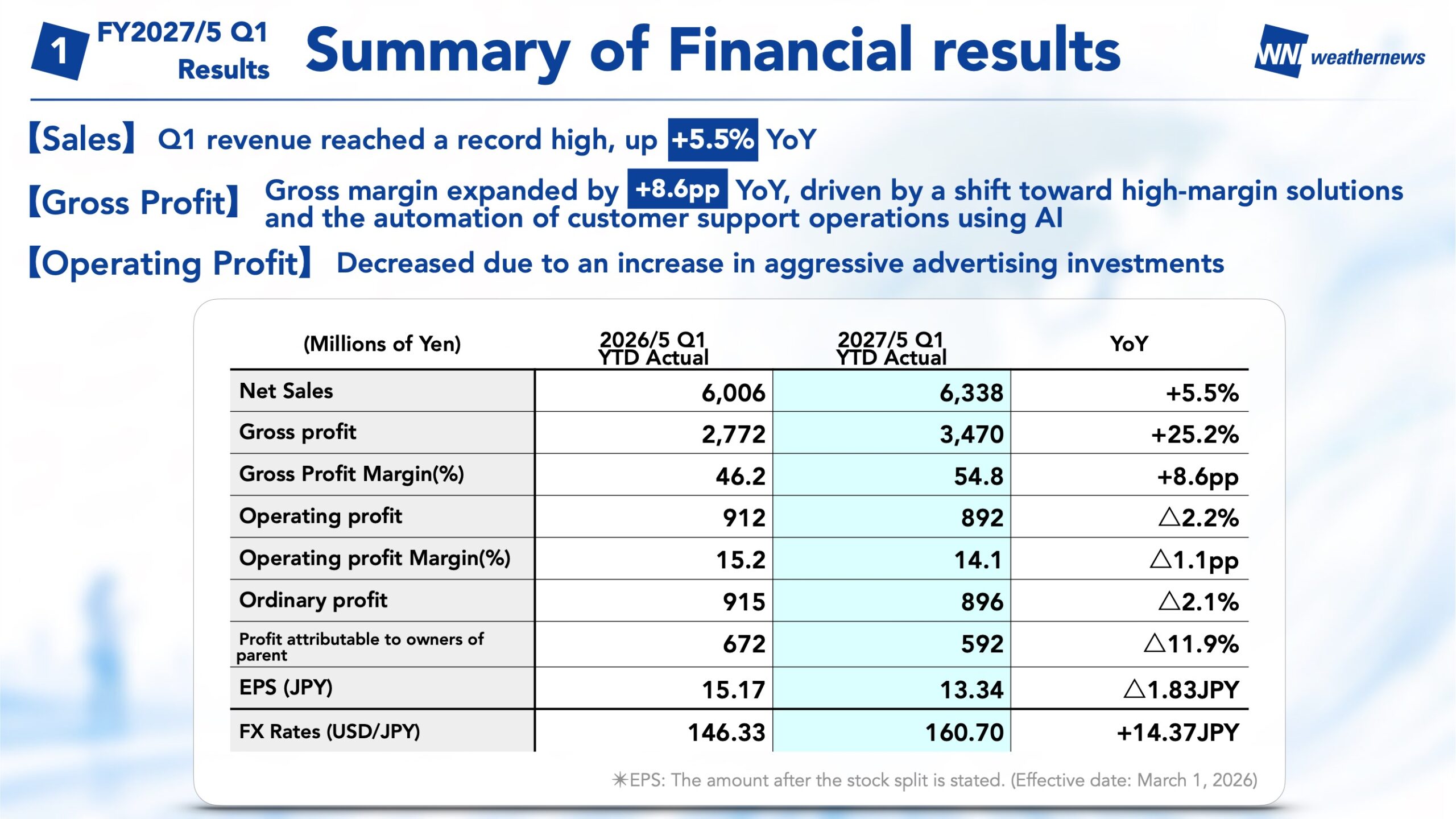
First, looking at the Q1 results, net sales increased by 5.5% year-on-year, progressing as planned, and we also made solid investments in advertising.
I will share more details later, but starting this fiscal year, we have begun disclosing our gross profit margin. It improved significantly by 8.6 percentage points to 54.8%.
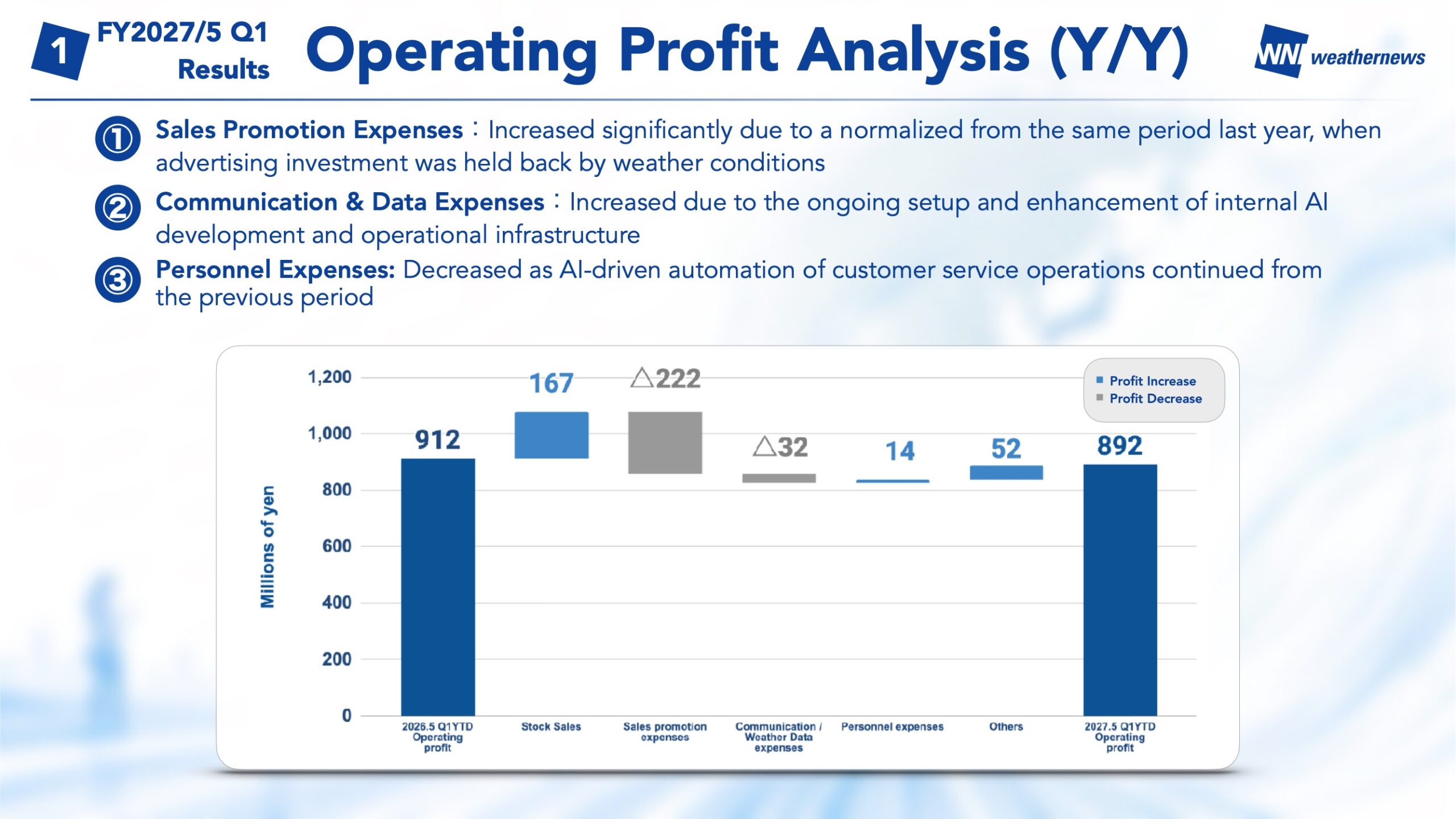
Next, I will explain the waterfall chart for operating profit variance. Our business structure is heavily influenced by sales promotion, communication, and personnel expenses. However, we steadily grew sales, made robust advertising investments, and kept other expenses largely unchanged compared to the same period last year. As a result, operating profit remained virtually flat year-on-year.
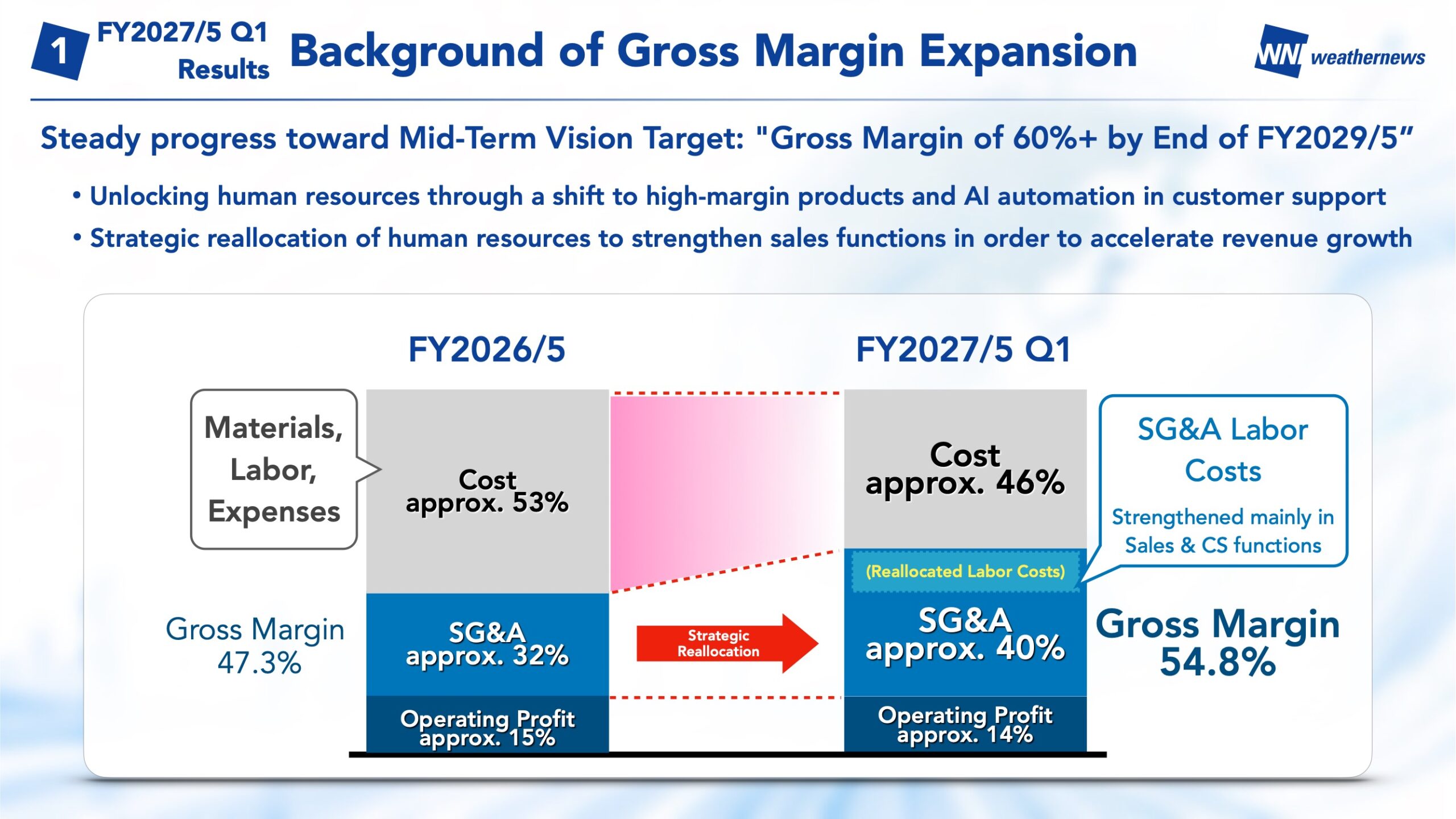
On the other hand, our gross profit margin showed a major improvement. Under our medium-term vision, we set a target to achieve a gross profit margin of 60% or higher by the fiscal year ending May 2029, and we have already reached 54.8% at this stage.
Since two fiscal years ago, we have been continuously leveraging AI and other technologies to improve our cost structure. Specifically, by using AI to automate on-site operational tasks—such as generating customized forecasts for clients—we have created surplus human resources and strategically redeployed those personnel. Rather than simply downsizing to cut reduced operational workload, we have begun reallocating a significant portion of these staff to Customer Success (CS).
These personnel are preparing to contribute to future revenue growth by strengthening CS operations, such as supporting client onboarding, explaining advanced service utilization methods, and promoting upsells to existing clients. In certain domains, such as the Land Domain, we are already starting to see positive results, so we expect our gross profit margin to improve even further.
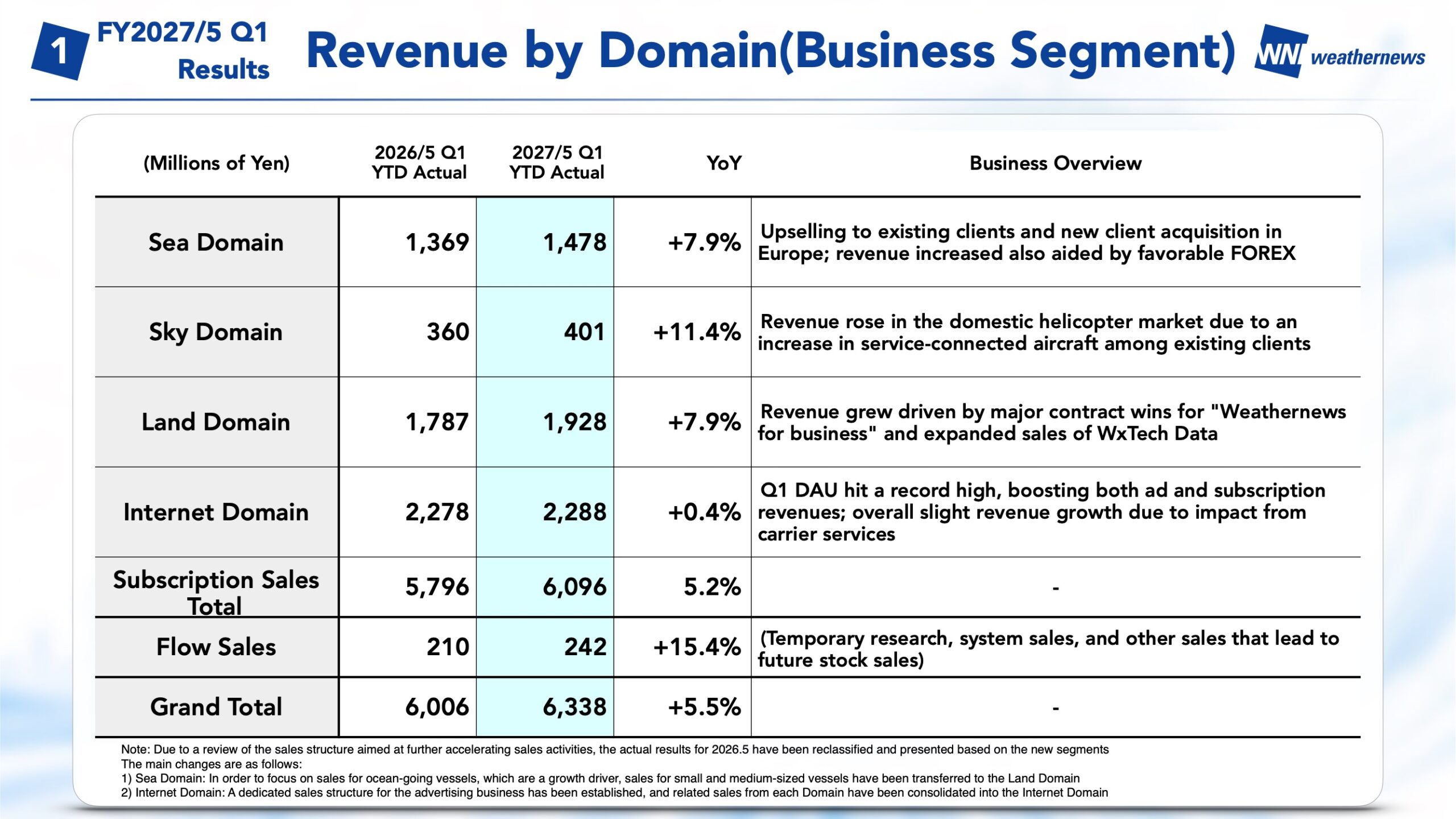
Next, let’s look at revenue by domain. I will provide individual details later, but Sea Domain and Land Domain grew by 7.9%, while Sky performed strongly, continuing its double-digit percentage growth. In the Internet Domain, revenue from in-house content expanded, but due to declines in other areas, overall domain revenue saw only a slight increase. Please note that the Sea Domain was also affected by foreign exchange fluctuations.
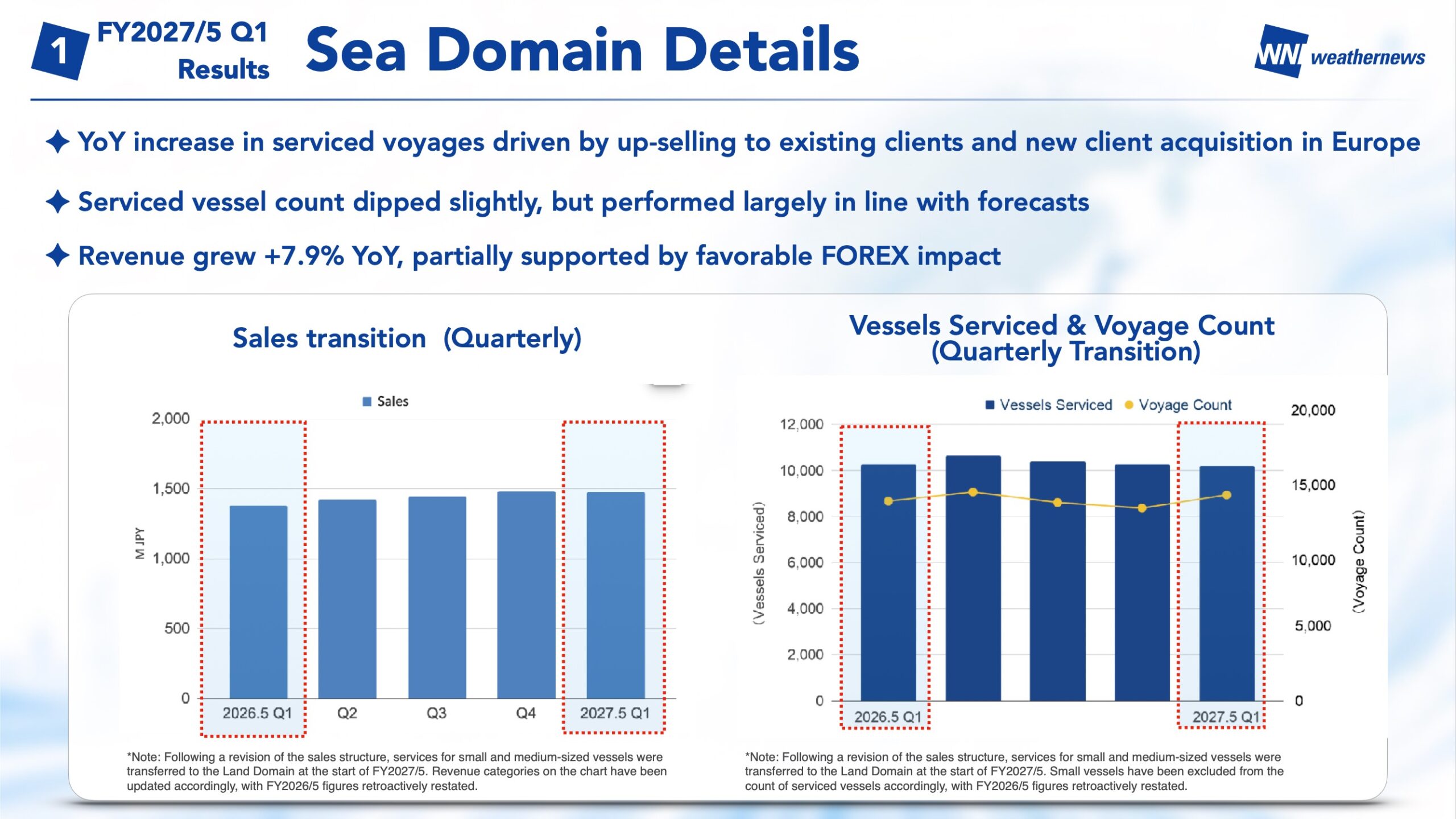
Here are the details for the Sea Domain. There has been a change in the revenue composition compared to previous fiscal years. Previously, sales from services for small and medium-sized vessels were included under Sea Domain revenue, but starting this fiscal year, they have been transferred to the Land Domain.
The reason for this is that coastal vessels—which make up the majority of small and medium-sized ships—operate mostly near Japanese coastal waters. Consequently, they have high demand for weather information related to port operations, such as being unable to load cargo during heavy downpours at port. Therefore, rather than routing services, we provide coastal weather information through our "Weathernews for Business" product tailored for coastal vessels.
Since sales activities for this product are handled more efficiently within the Land Domain, revenue from coastal vessels has been reclassified under Land Domain starting this fiscal year. As for the Sea Domain, it now focuses exclusively on the ocean-going vessel business for long-haul voyages.
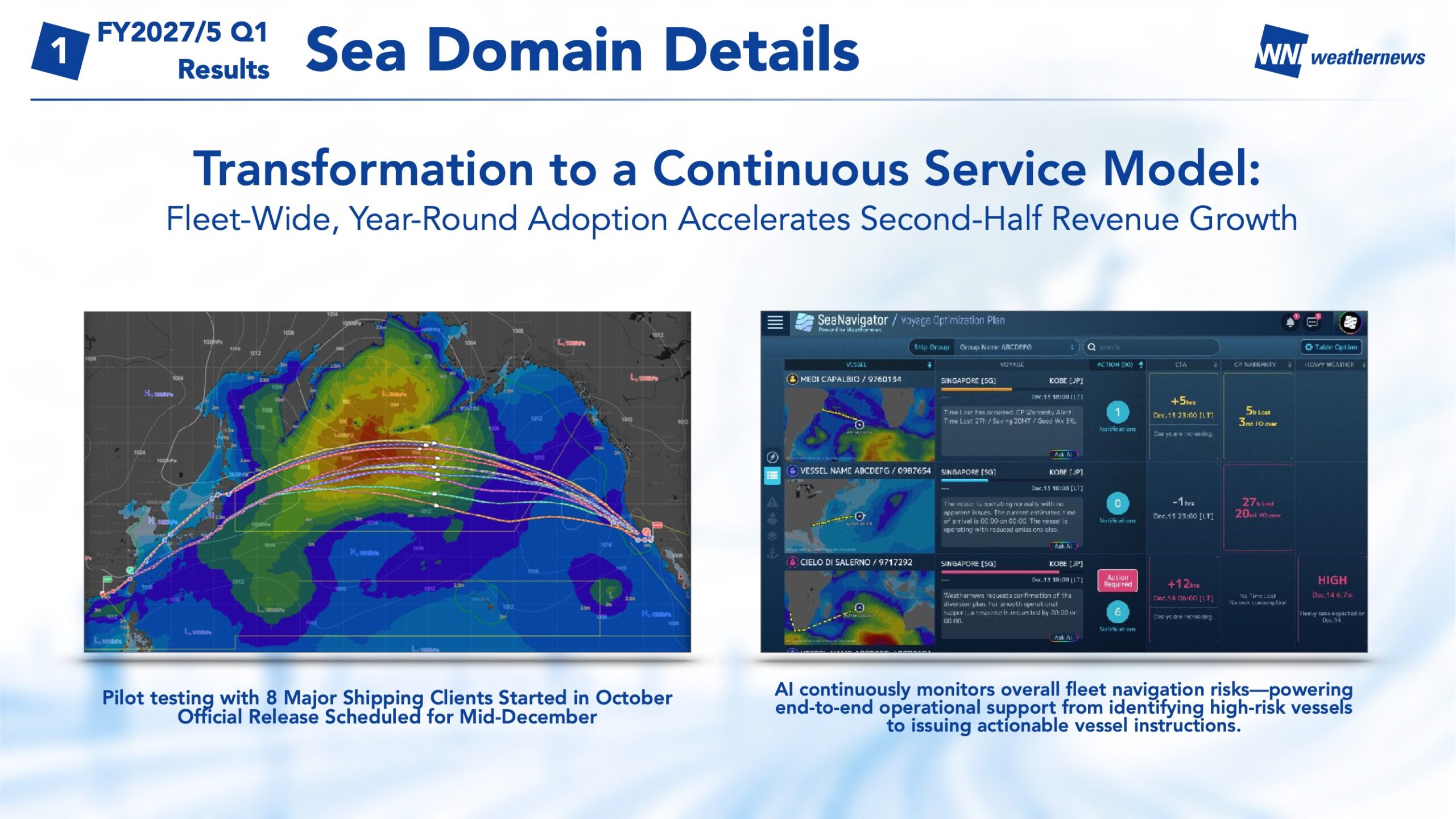
Regarding the Sea Domain, a transformation is underway as we evolve from a traditional routing provider into a company offering broader, comprehensive solutions. We are shifting from a spot-based revenue model per voyage to a model where AI continuously monitors all vessels managed by a client.
In the second half of this fiscal year, we plan to execute one of the transitions in this business model transformation, which is expected to drive revenue growth. Under this product, AI constantly monitors all ships and, upon detecting any issue, sends alerts to the client while proposing alternative voyage plans. We have already initiated pilot testing and plan to roll this out to various clients afterward, so please stay tuned for the second half of this fiscal year.

Moving on to the Sky Domain. This domain continues to perform strongly, with our flagship product, "SkyAviators," now supporting 14,000 airports globally. In Japan, we are also beginning to provide data services for the commercial drone market.
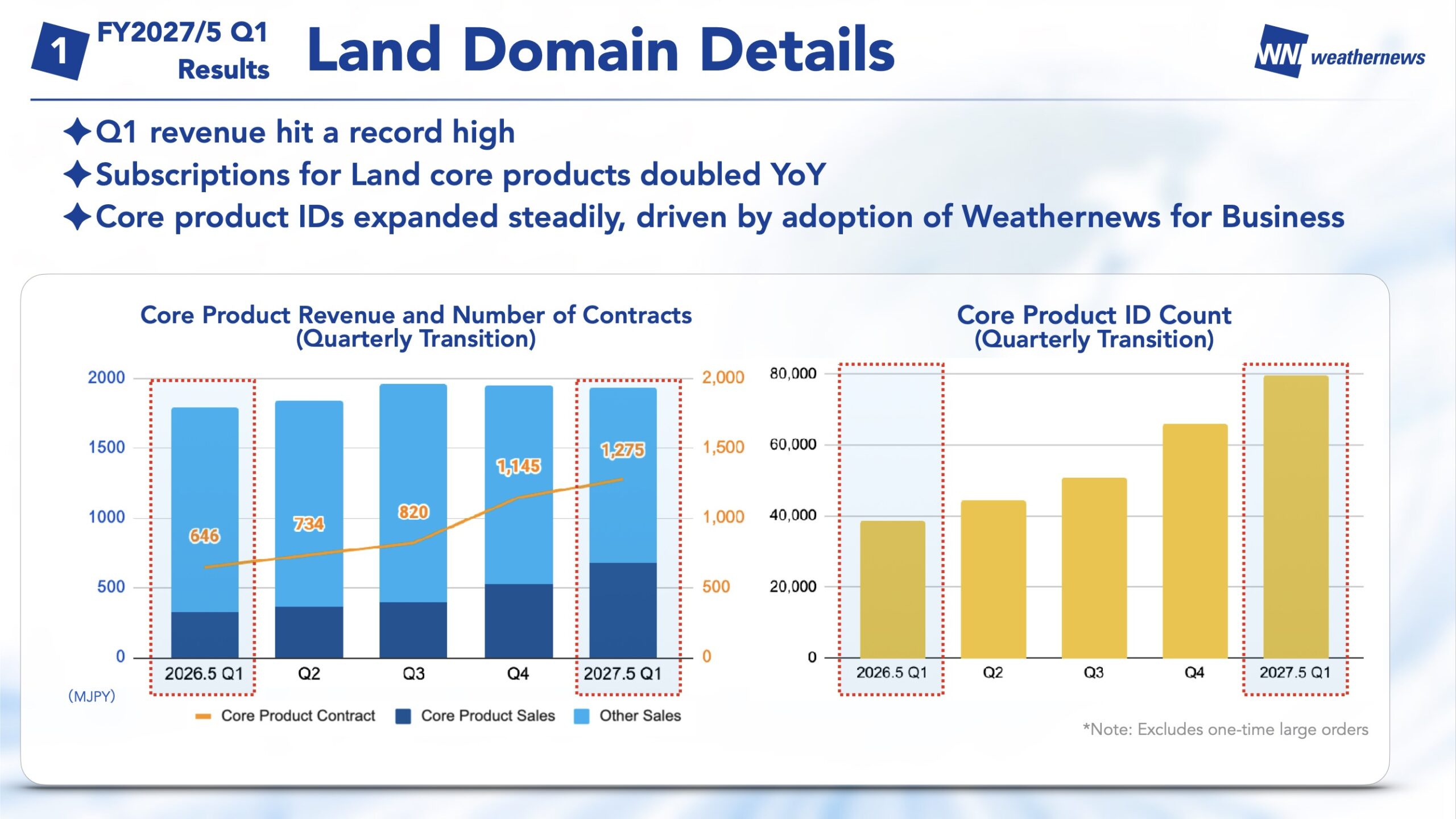
Next is the Land Domain, which reached record-high sales. Sales of Land core products have been exceptionally strong.
"Core products" refers collectively to hardware sales of observation equipment, data provision services, and "Weathernews for Business"—a service that enables clients to use our weather app for business purposes across both PC and mobile devices. The dark blue portion of the chart represents revenue from these Land core products.
Both the number of contracts and ID counts for core products are growing steadily. Recently, we have also begun securing orders for Weathernews for Business from large enterprise clients, making core products an area where we expect accelerated growth going forward.
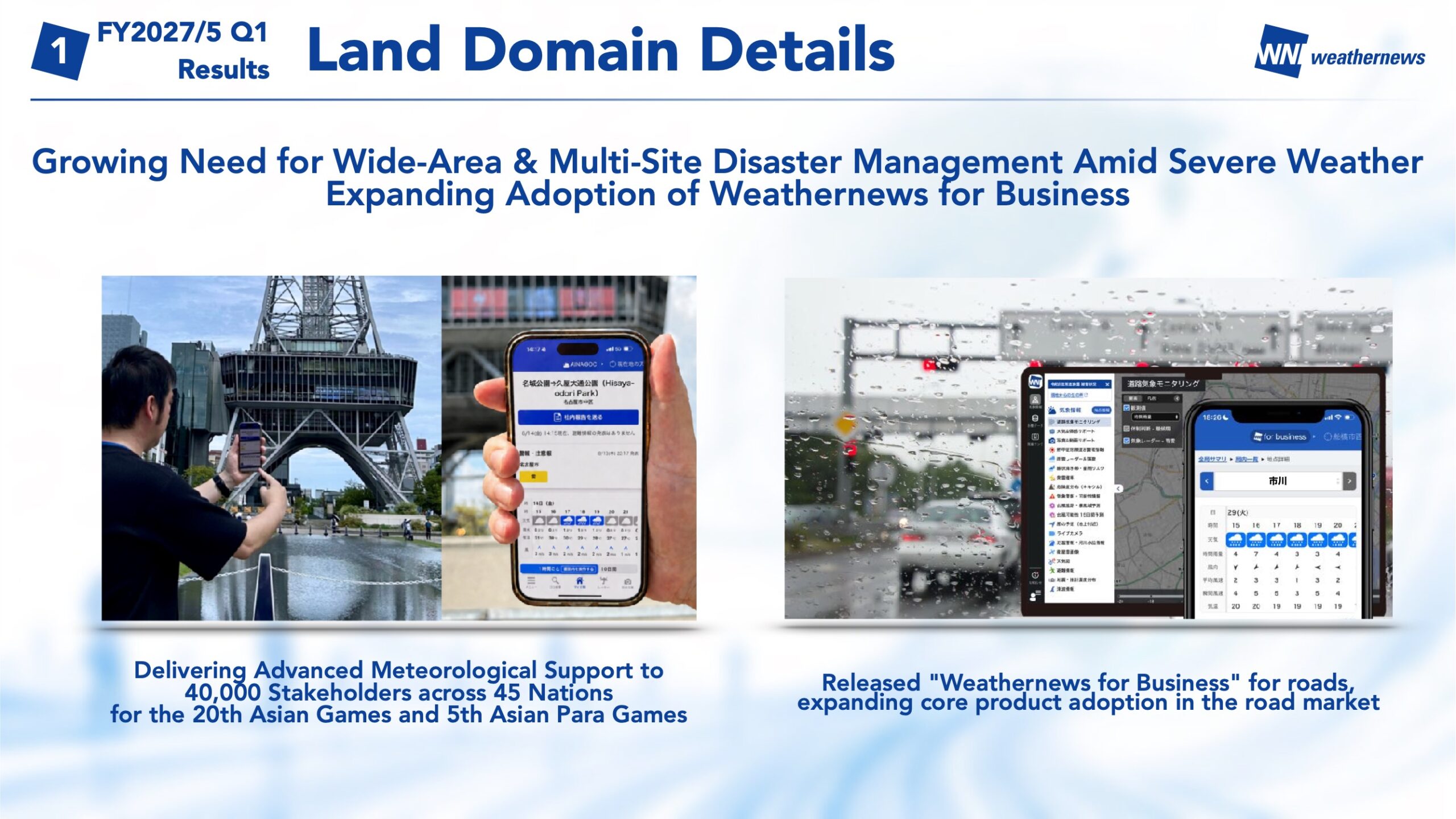
Continuing with topics in the Land Domain: we are currently providing weather information to 40,000 users through Weathernews for Business at the ongoing Asian Games and Asian Para Games. Since this is a spot contract, these 40,000 users are not included in the ID count shown in the yellow graph.
Furthermore, our long-standing services for the road sector are gradually being transitioned to the Weathernews for Business platform. Driven by these initiatives, we anticipate that the scale of utilization will expand rapidly.
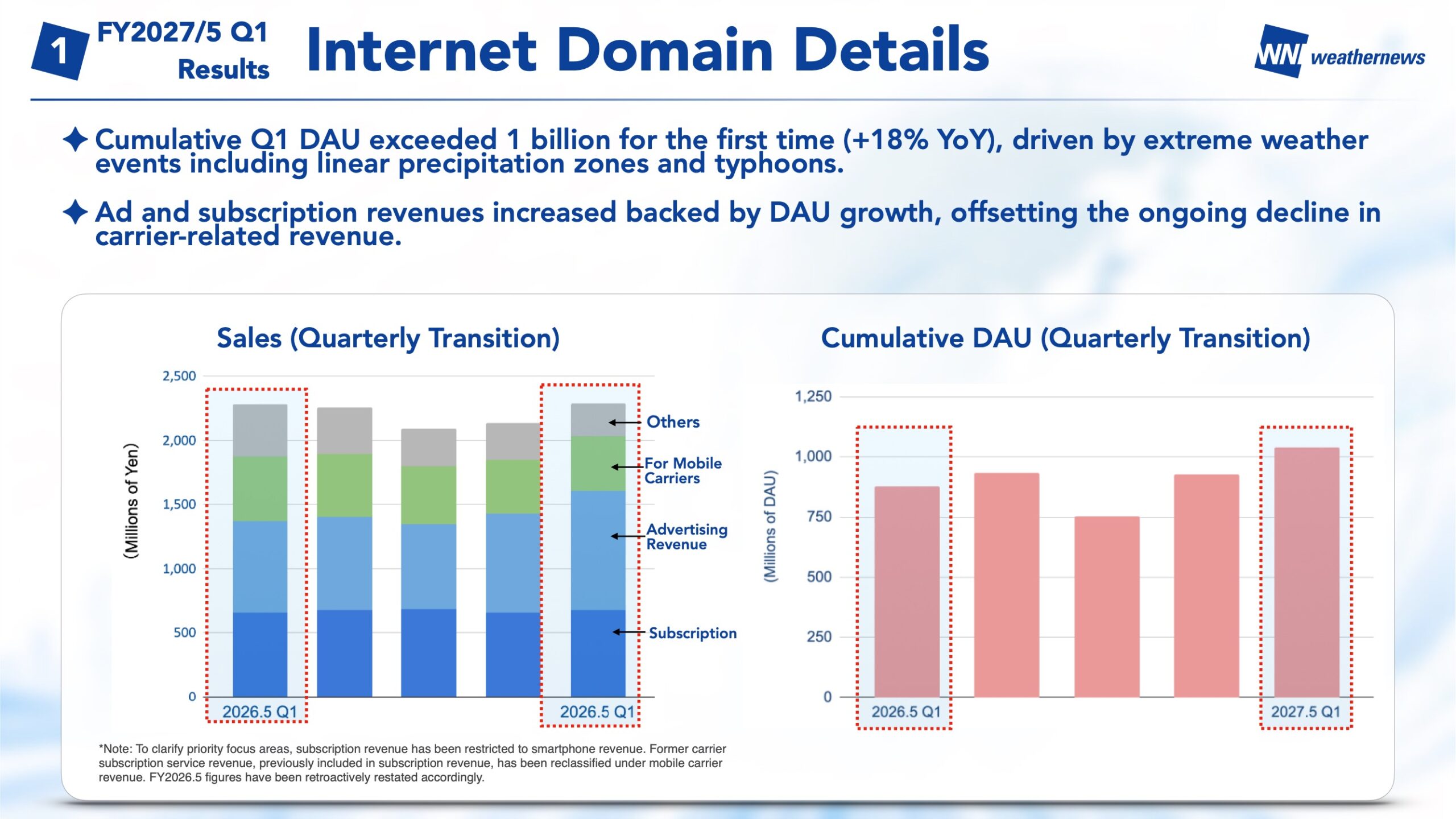
Finally, the Internet Domain. Due to a solid rainy season in Japan this year, our cumulative Q1 DAU (Daily Active Users) surpassed the 1-billion milestone for the first time. Correspondingly, the "Advertising" portion of revenue (shown in light blue on the bar chart) expanded solidly.
On the other hand, comparing YoY, "Others" and "For Telecom Carriers" (shown in gray and green) declined. This is due to a reduction in data provision for mobile carriers and certain device manufacturers. Going forward, our strategy is to strengthen our proprietary app and website to drive growth in both advertising revenue and subscriptions. We consider this fiscal year to be a transition year for that strategy.
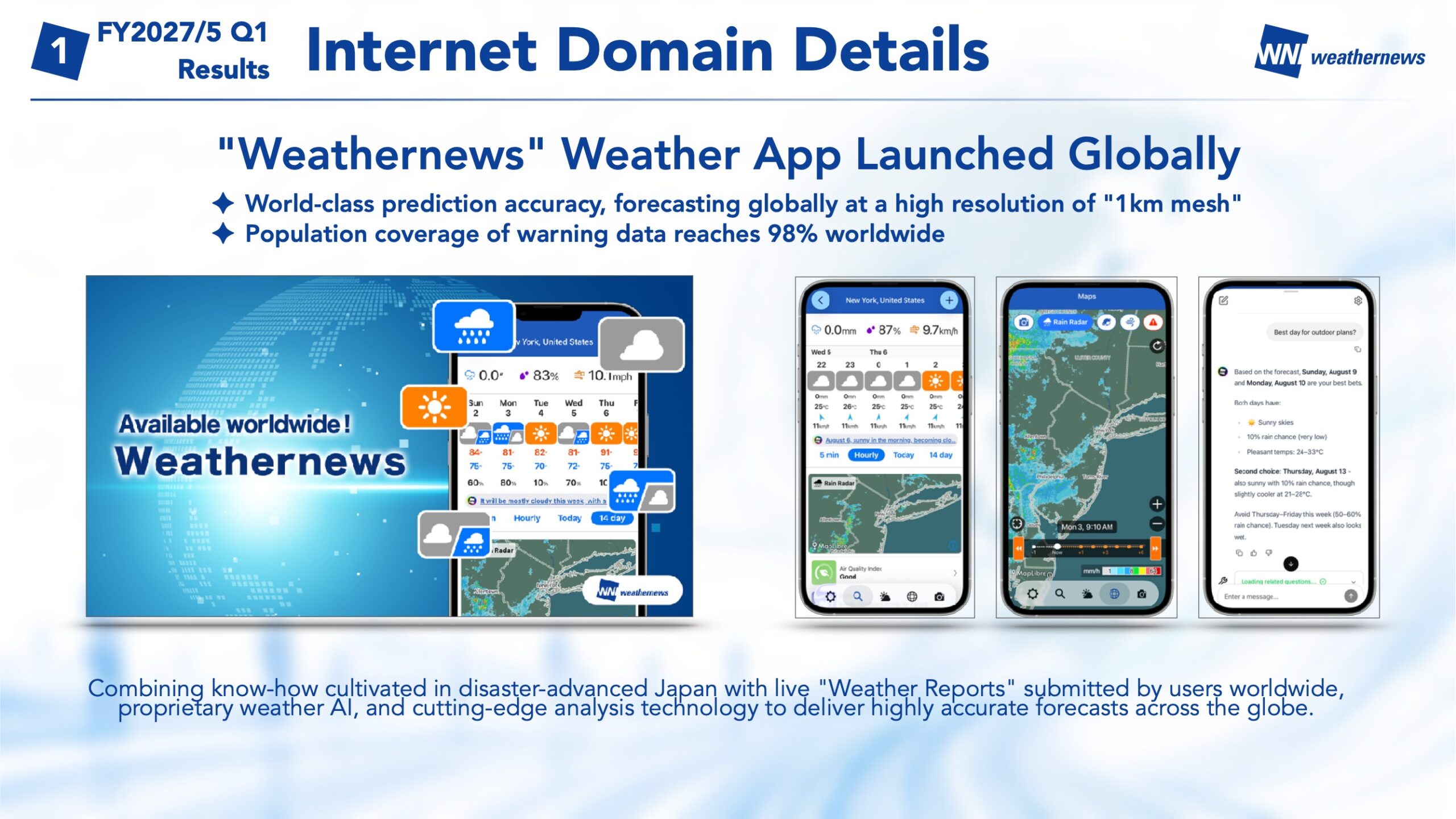
As a key topic—which has already been announced via press release—the Weathernews app is now available globally. Users worldwide can now view high-precision weather forecasts on a 1-km mesh grid wherever they go. Our warning and alert data now covers 98% of the global population. Naturally, users can also send Weather Reports.
While this global push does not yet have a significant revenue impact compared to our domestic business in Japan, we are steadily preparing for our global expansion.
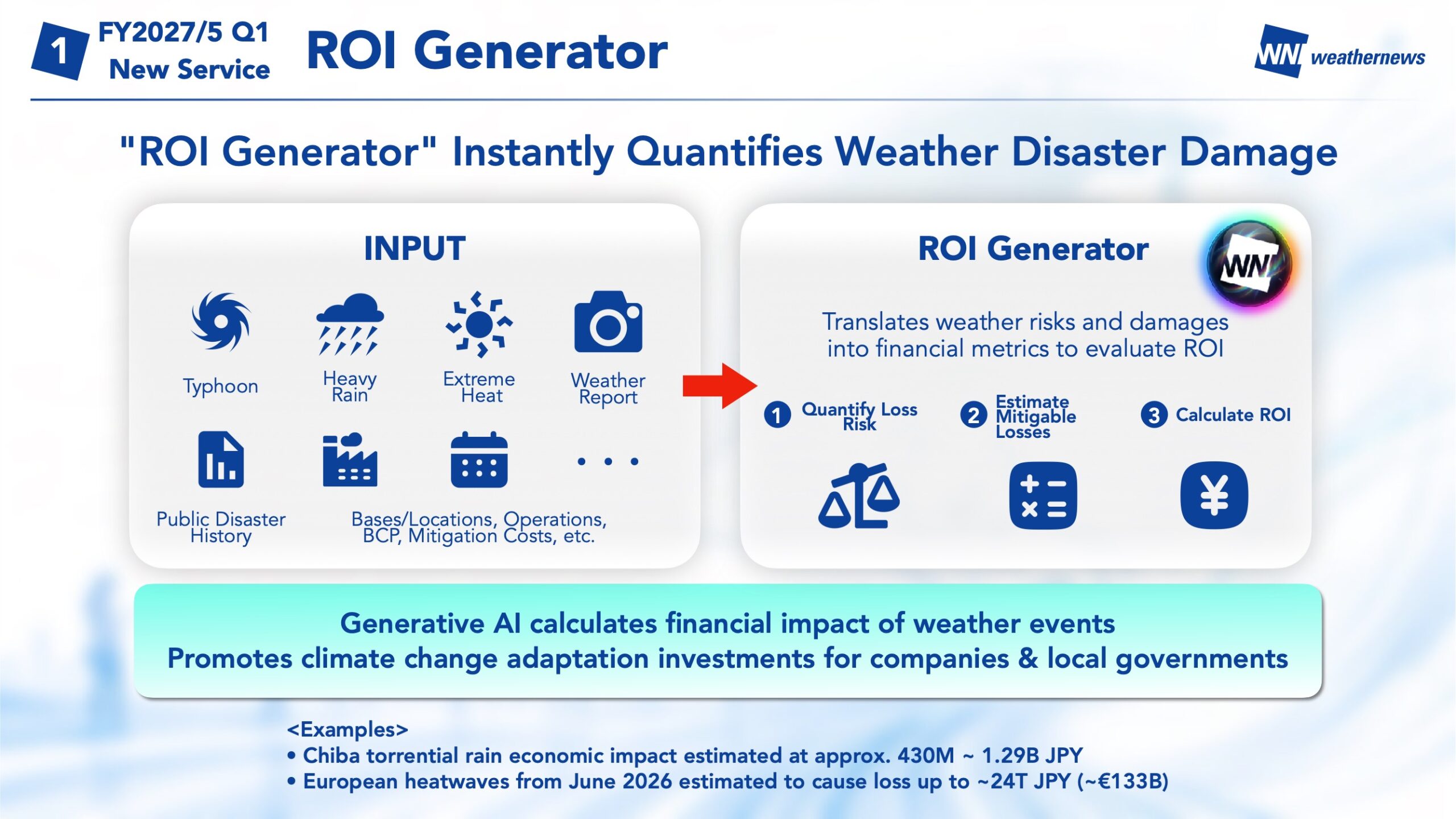
Lastly, I would like to introduce a new service: the "ROI Generator."
This tool analyzes a client's business operations to calculate and visualize the exact return on investment (our service fee) achieved by using Weathernews services. By presenting clear numerical metrics on "how much return can be achieved for a given investment" regarding past and future weather risks, we expect this tool to accelerate service sales.
A dedicated team is driving the development of this service. Its core strength lies in its ability to quickly calculate custom ROI for each client's specific operations by using AI to ingest and analyze academic papers, government calculation formulas, and other data sources. We will continue to refine its features and utilize it as a key solution to drive sales activities and revenue expansion.
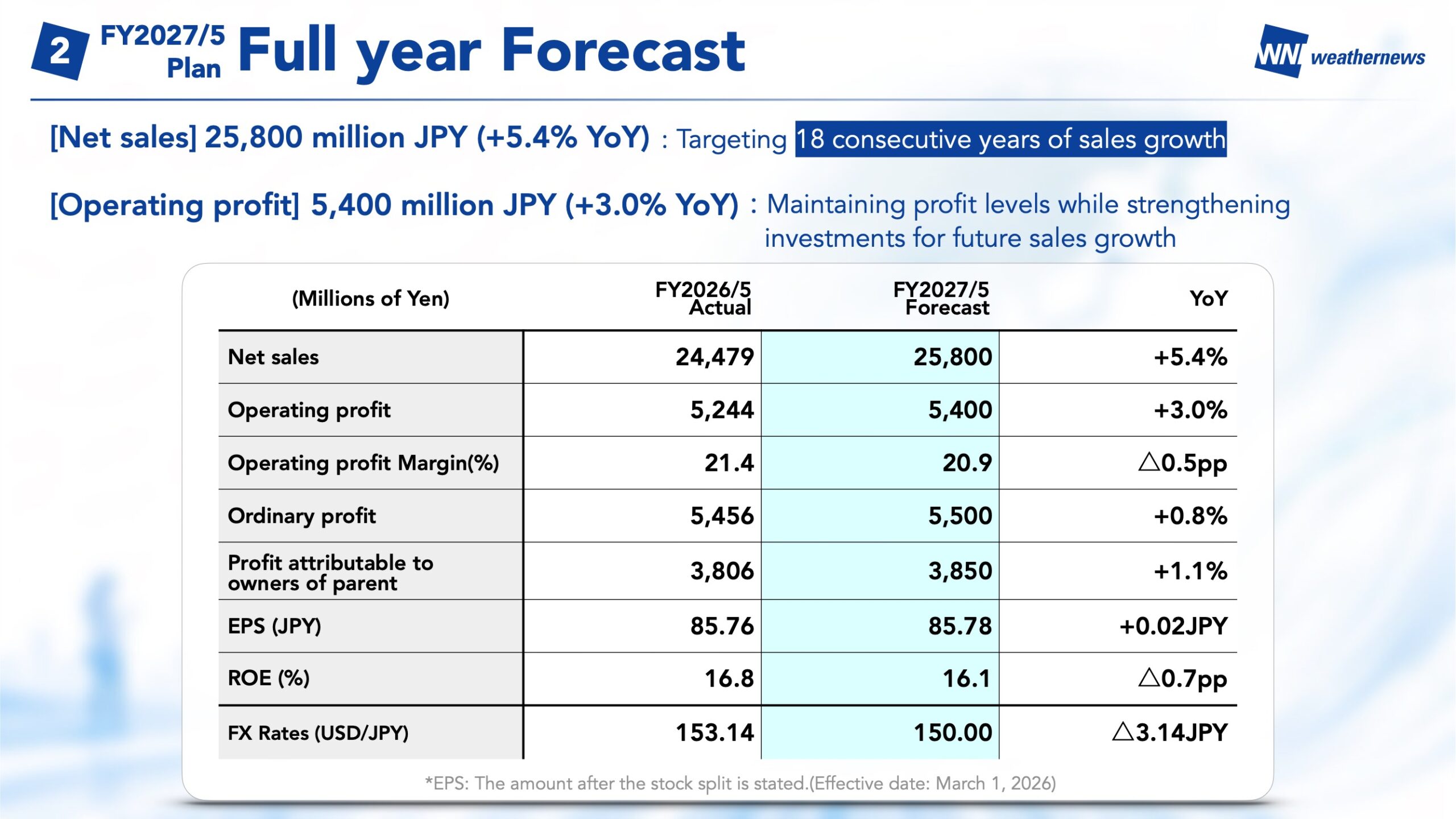
Regarding our full-year earnings forecast, there are no changes from our previous announcement.
We project net sales of 25.8 billion yen (marking 18 consecutive fiscal years of sales growth) and operating profit of 5.4 billion yen. We plan to make firm growth investments, including advertising.
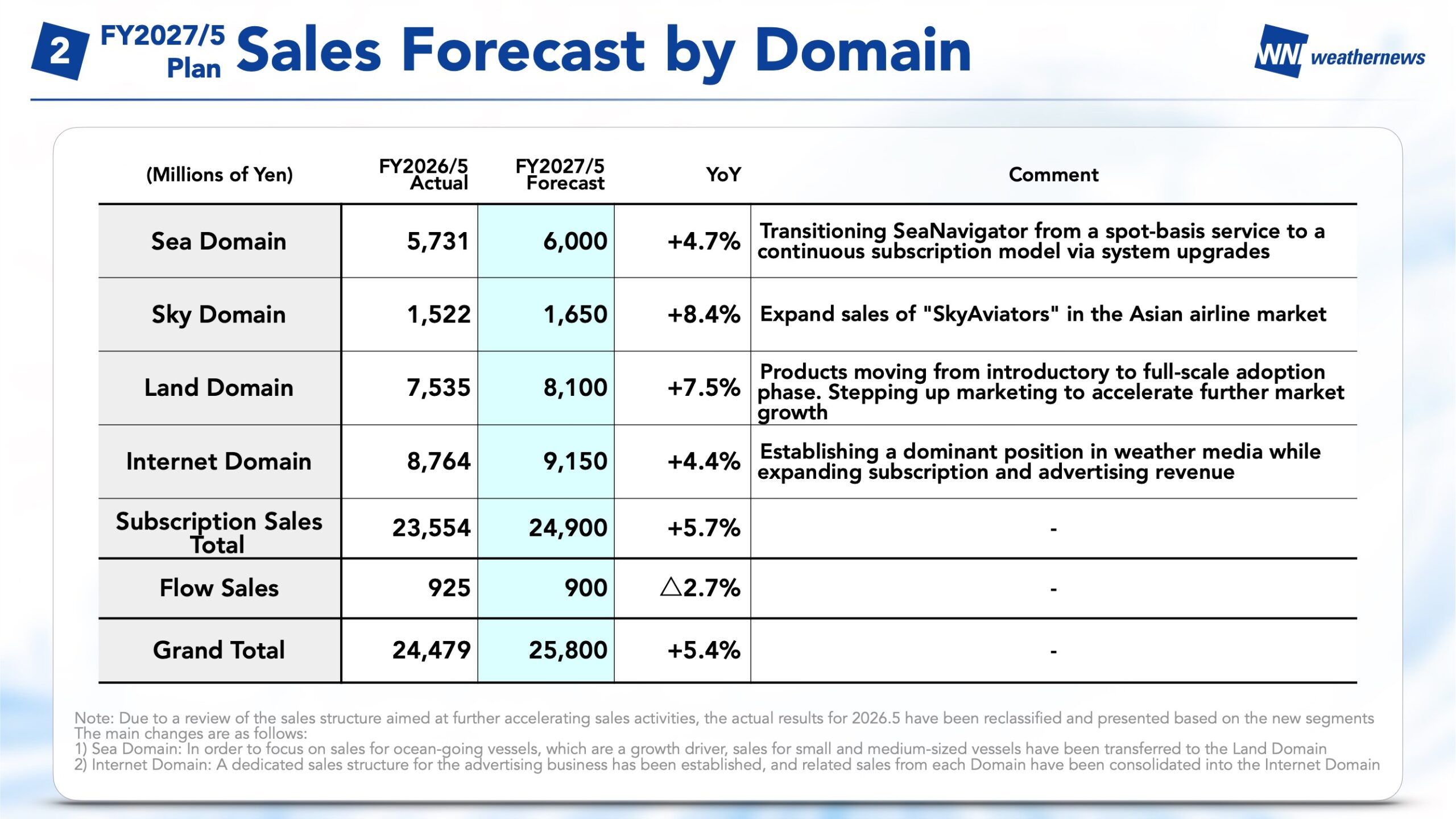
There are also no changes to our revenue forecast by domain. For the Sea Domain, please look forward to the "SeaNavigator" upgrade scheduled for the second half of the year.
For "SkyAviators" in the Sky Domain, we will continue expanding our services steadily, particularly in Asia.
In the Land Domain, we will aggressively expand core products such as Weathernews for Business, which is performing exceptionally well. In the Internet Domain, we plan to grow our owned media while advancing investments globally.
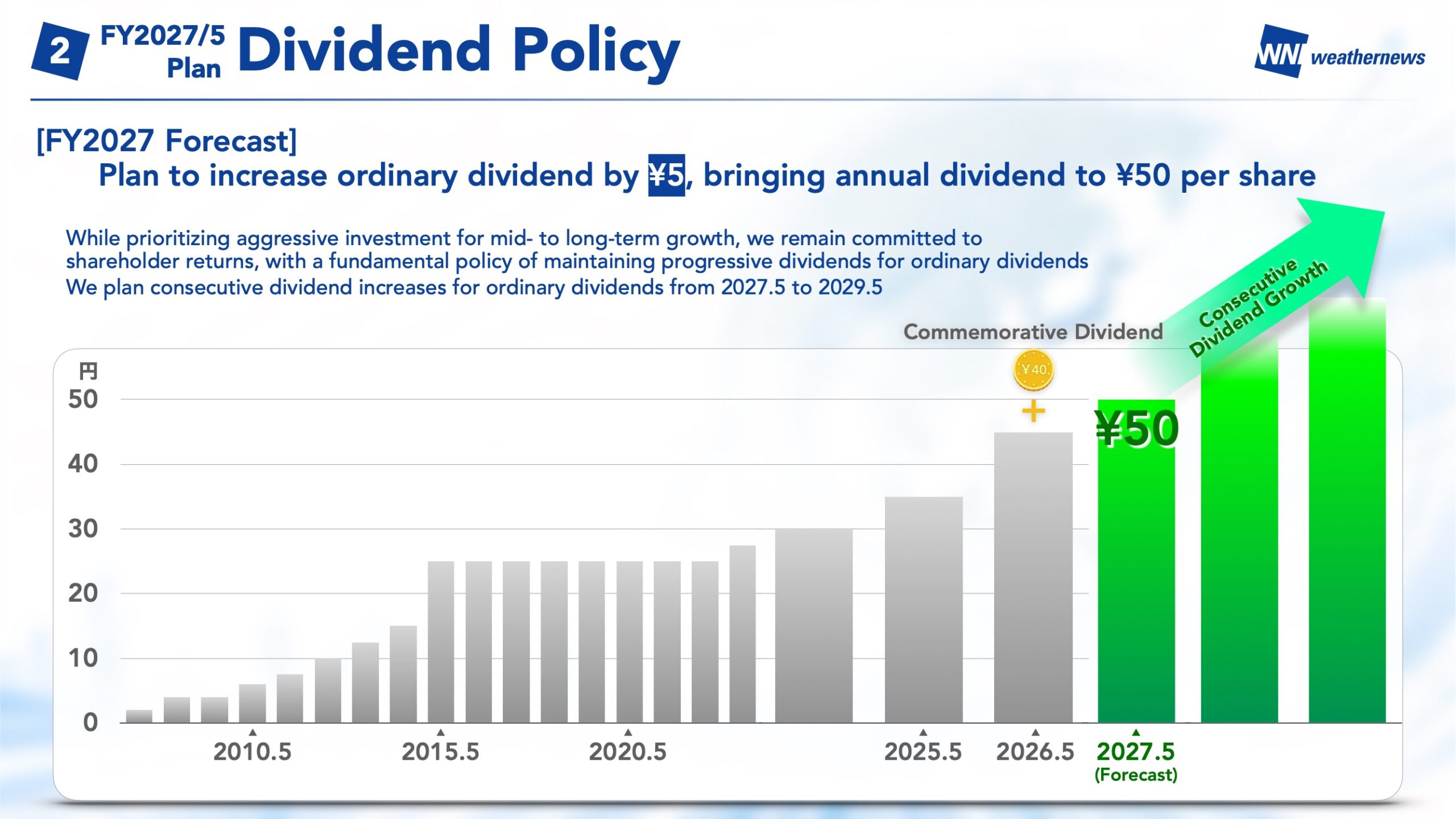
Finally, regarding our dividend policy, there are no changes here as well. For this fiscal year, we plan to increase the ordinary dividend by 5 yen, bringing the annual dividend to 50 yen per share. We plan to continue increasing dividends every year going forward.
This concludes my presentation.
Q&A
[Q1]: Are there any upside or downside risks to the full-year forecast?
Ishibashi [A]: At present, geopolitical risks have not had a significant impact on our business. While factors like exchange rate fluctuations are beyond our control, we believe the full-year target is fully achievable as each domain prepares for growth in the second half. Therefore, we are maintaining our earnings forecast.
[Q2]: What is the status of sales progress in Asia for the Sea Domain? Also, will the price of SeaNavigator increase substantially with the upcoming version upgrade?
Ishibashi [A]: First, regarding this first quarter, European operations ended up contributing to revenue, with Asian progress planned to follow. As for the pricing of SeaNavigator, we have no plans to raise prices immediately upon the version upgrade at this time. Our plan is to first have clients adopt our AI products so they can experience firsthand how much their operational efficiency improves, leveraging that reputation to accelerate switching from competitors. Once our client base expands sufficiently, we expect to enrich AI-driven value-added content over time, at which point we will firmly aim for upsells.
[Q3]: Why was there a slight decrease in the number of serviced vessels in the Sea Domain in Q1?
Ishibashi [A]: This was due to a slowdown in vessel chartering activity caused by changing market conditions. Even when servicing the same vessel, if the operating client changes, the way vessels are counted changes accordingly. As a result, the vessel count decreased slightly, but the actual volume of service provision was firmly maintained.
[Q4]: Regarding the Sky Domain, what is the progress in acquiring airline clients in Asia?
Ishibashi [A]: Acquiring airline clients in the Sky Domain typically takes more time compared to Sea and other domains, but we are making steady progress in line with our full-year acquisition plan.
[Q5]: Could you specify what you mean by large enterprise orders in the Land Domain?
Ishibashi [A]: These refer to existing major clients such as infrastructure companies, electric power utilities, and logistics firms. We are beginning to transition clients from custom-built legacy systems to our standardized core products.
[Q6]: Growth in the Internet Domain appears slow relative to the annual target. How do you evaluate this?
Ishibashi [A]: We do not feel that Q1 fell behind schedule. On the other hand, since our plan calls for further growth in ad revenue in the second half, our challenge will be to enhance our owned media capabilities, increase content views, and reliably convert that into ad revenue.
[Q7]: What are your initial impressions regarding overseas expansion in the Internet Domain? As it has just begun, please share what you can.
Ishibashi [A]: Looking ahead to the next fiscal year and beyond, this fiscal year is focused on conducting marketing across many countries. We are starting to gain visibility into advertising revenue and ad unit prices in each country. Based on these results, we expect to see a clearer direction for our next investment.
[Q8]: It feels like the growth in operational time reduction from AI utilization is slowing down. Is there still room for further reduction?
Ishibashi [A]: We view this fiscal year as a transition period. Rather than focusing solely on automating all remaining legacy customer support tasks this year, we are prioritizing the redeployment and retraining of freed-up resources into strengthening Customer Success functions. Under our three-year medium-term vision, the goal is to automate virtually all existing routine operations with AI, so from a long-term perspective, operational reductions will continue.
[Q9]: Could you provide a more concrete explanation of the background behind the gross profit margin improvement? Specifically, what type of staff are gaining spare capacity through AI, where are they being redeployed, and what results are you seeing?
Ishibashi [A]: Specific examples of customer-facing operational tasks include customizing forecasts for individual markets and preparing service evaluation materials for clients. AI automation of these tasks is progressing rapidly. Staff previously assigned to these roles are being redeployed to Customer Success functions to enhance client onboarding support. While retraining and domain-specific relearning take some time, these employees already possess substantial domain knowledge from servicing these markets and are not complete beginners. As a result, we expect them to become productive very quickly.
[Q10]: Does the full-year forecast for the Internet Domain incorporate overseas business?
Ishibashi [A]: It does not include overseas business at all; the revenue plan is based strictly on domestic operations.
[Q11]: Could you explain your approach to spending sales promotion expenses? Do you spend strictly according to budget, or would you accelerate spending if cost-effectiveness is proven?
Ishibashi [A]: For the Internet Domain, we track metrics like CAC and CPI, so cost-effectiveness is relatively clear, and our promotional spending plans are based on those metrics. However, promotional spending related to B2B represents a new initiative, so we are currently in a marketing investment phase to analyze and understand those numbers.
[Q12]: Regarding the new ROI Generator service: clients likely already had a rough sense that ROI on existing services was around 10%. Will visualizing this more specifically create opportunities for further cross-selling and upselling?
Ishibashi [A]: The primary objective of the ROI Generator is to serve as a tool to accelerate the closing speed of new contracts, so we intend to focus on that first. That being said, we hold extensive historical data from serving clients, and by analyzing existing clients' cost structures based on that data, we believe it will also become a highly effective tool for upselling and cross-selling.